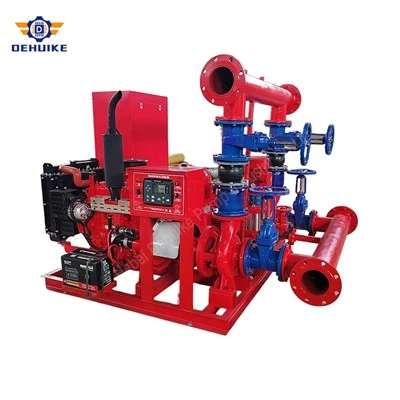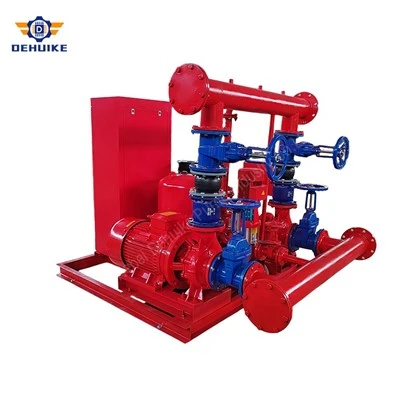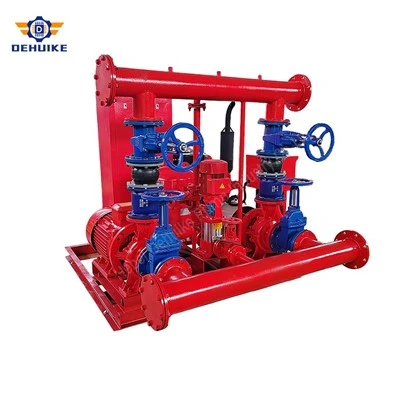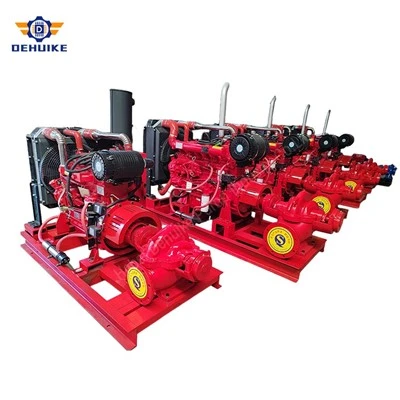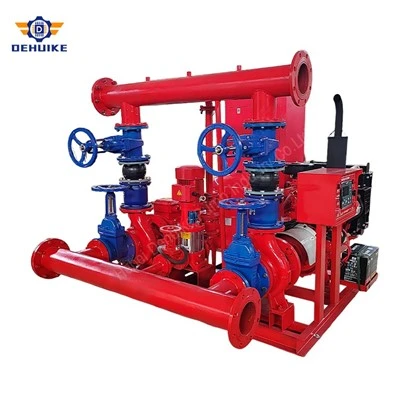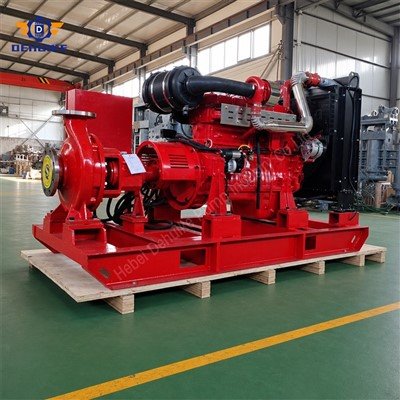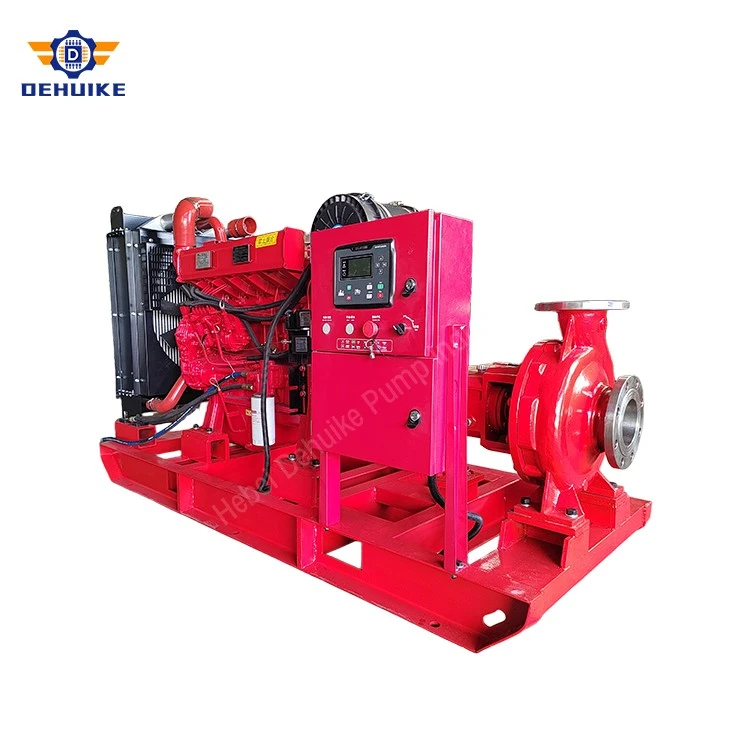
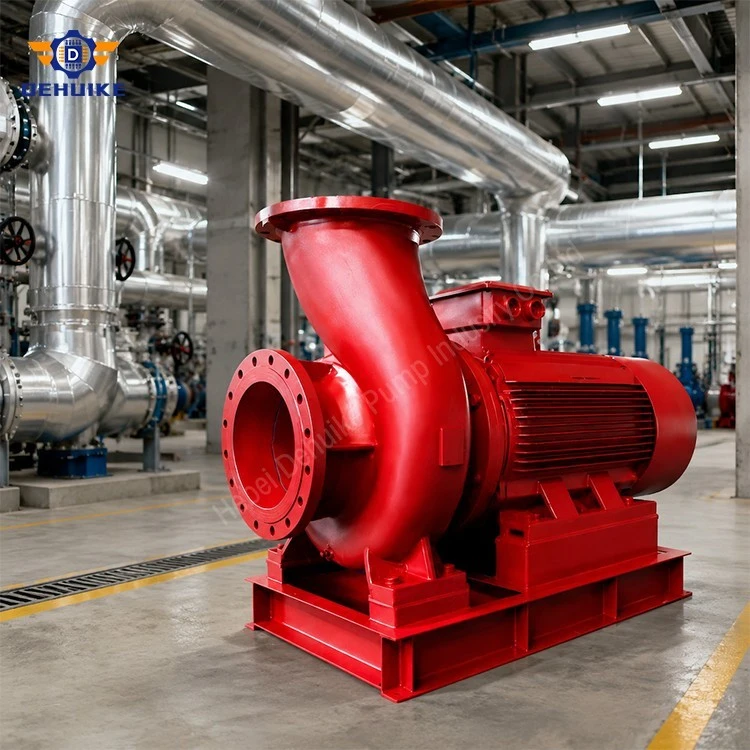
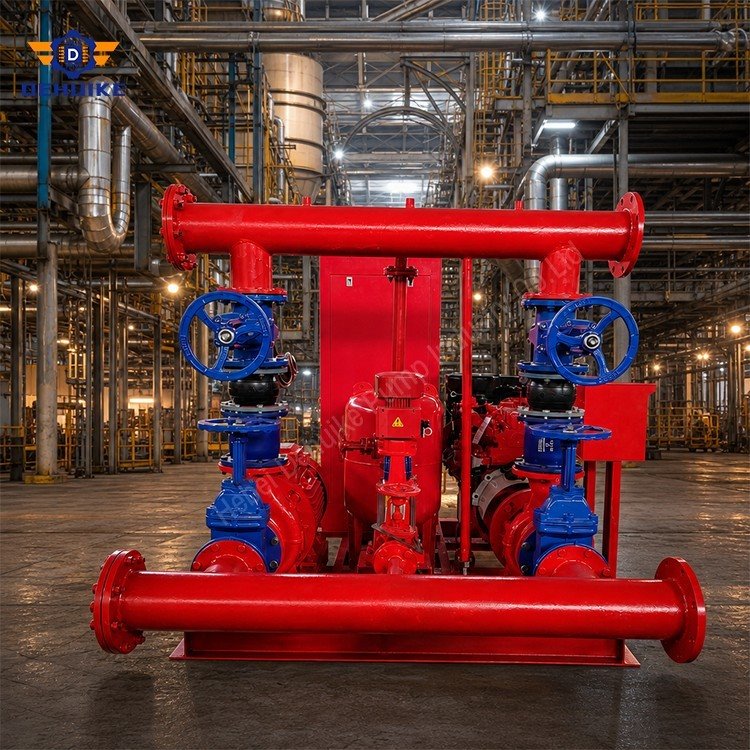
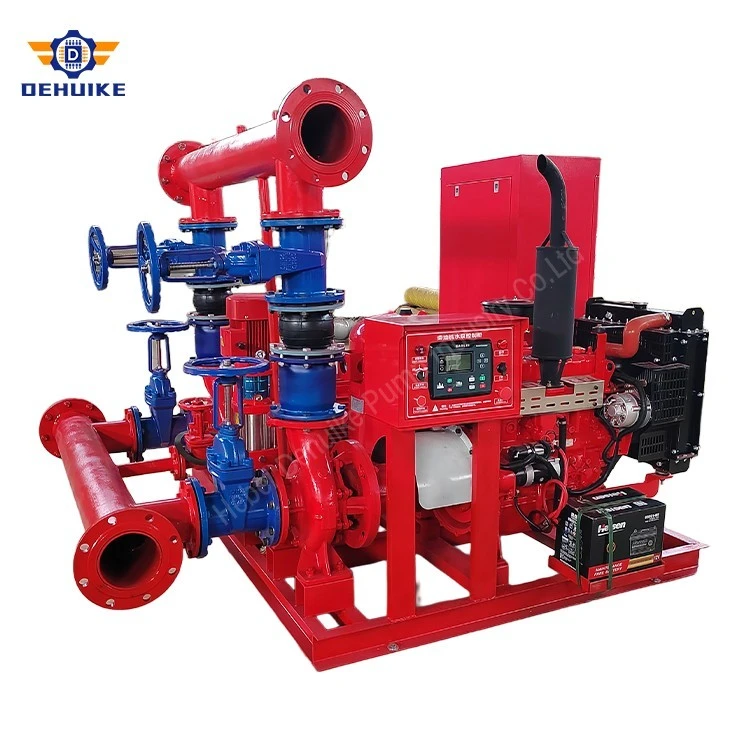
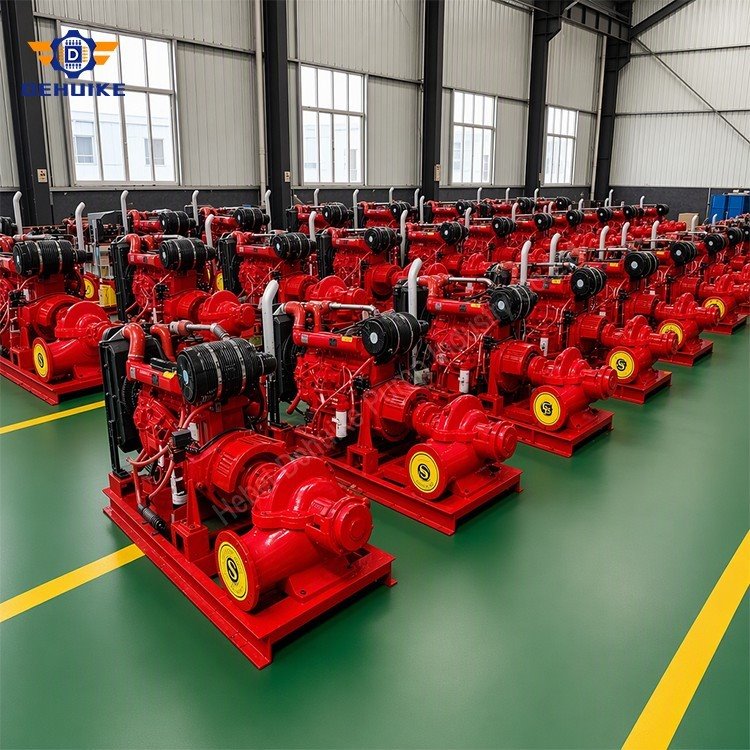
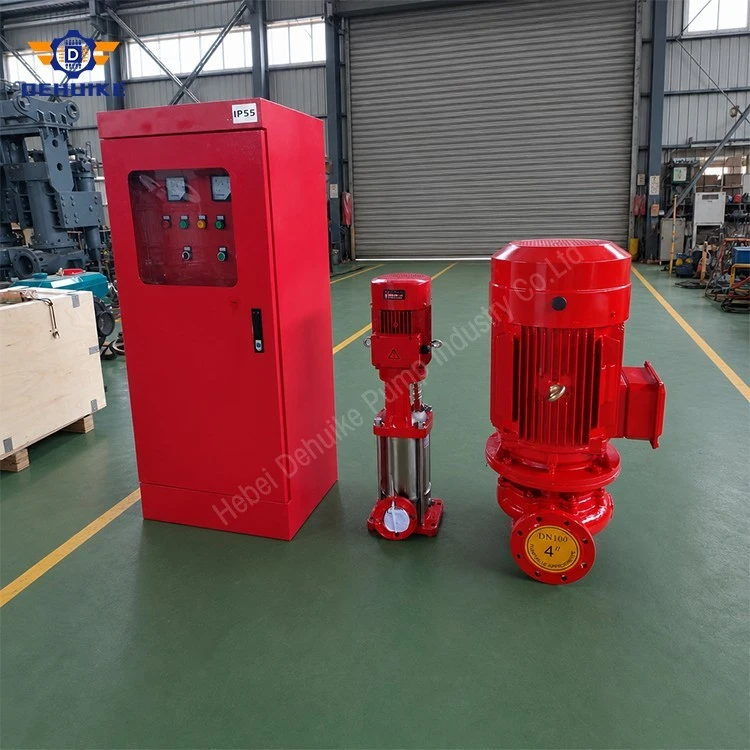
Hebei Dehuike Pump Industry Co., Ltd. is one of the most reliable manufacturers and suppliers of split case fire pump set in China. With abundant experience, we are committed to providing high quality customized pumps with competitive price. Welcome to wholesale bulk split case fire pump set for sale here from our factory. Also, pricelist is available.
Introduction
Nobody buys a fire pump for the day it arrives. It is bought for the night a sprinkler head opens on the fifth floor. That is the test the specification has to pass, and it explains why starting behaviour, test access and proof of duty outweigh cosmetic details in the quotation.
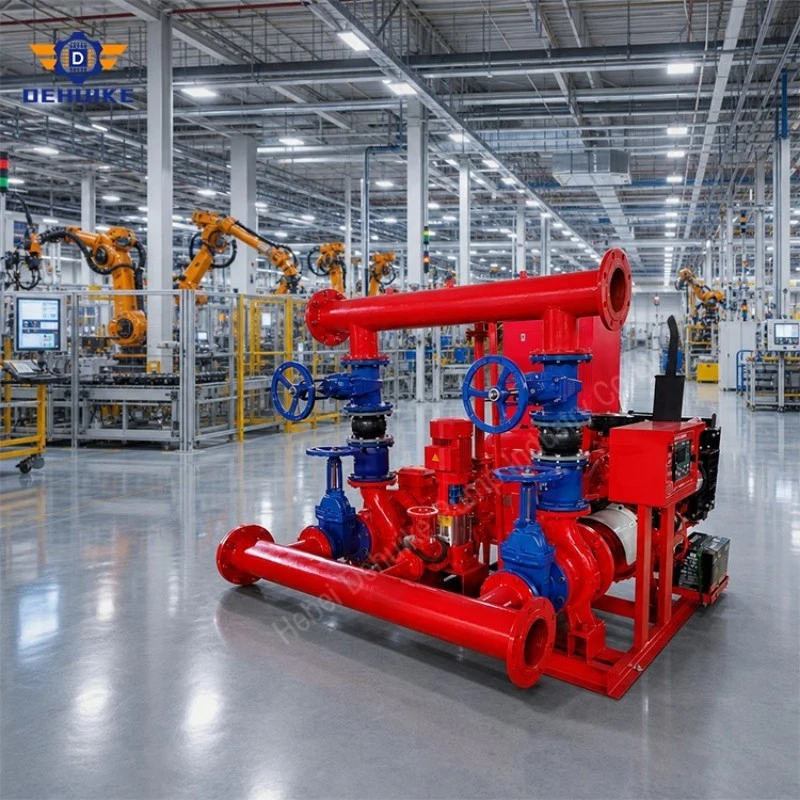
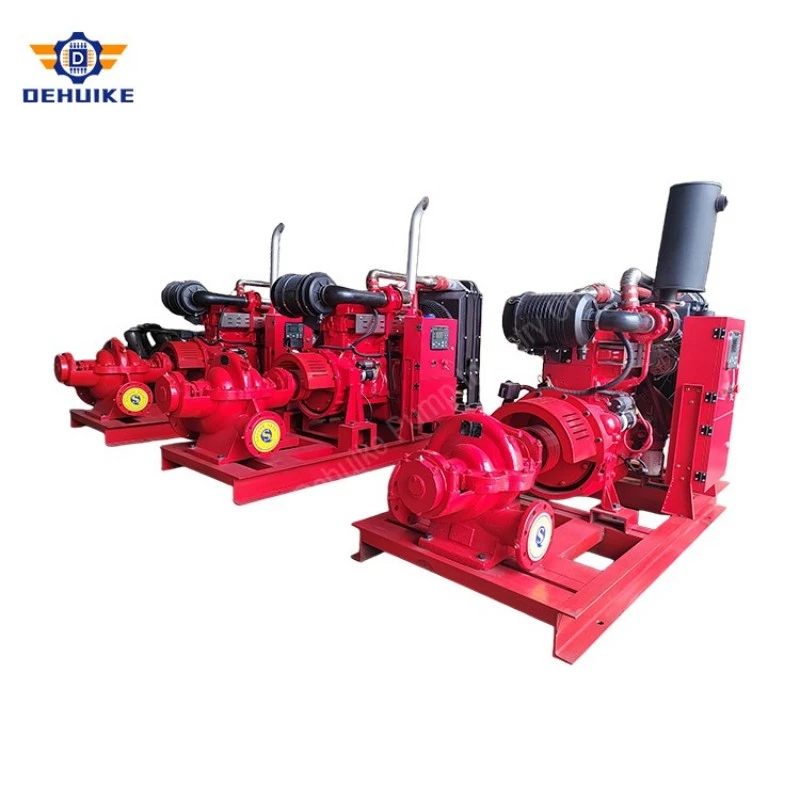
The split case set is a pedestal-mounted horizontal package with a single double-suction wheel. Its housing comes apart at mid-height, which lets the top half be lifted and the rotating parts withdrawn while the flanges stay put. Large fire flows at moderate head are its territory: warehouses, factories, municipal stations, not cramped basements.
What follows tracks the order a project really decides in: duty, curve, scope, intake, controls, space, documents. Clean water fire service only. Slurry, chemical and process work are separate selections and outside this page.
Where the Duty Comes From
The flow figure should come from the fire calculation, not from a pump catalogue. Sprinkler density and design area, the number of hydrants assumed open at once, or both, set the demand at the base of the riser. Ask for that number together with its basis. A unit rated at 80 L/s proves nothing if the building only needs 45, and it is a poor buy if the building needs 95.
Units cause more confusion here than anywhere else in the selection. One litre per second is 3.6 m3 per hour, so a 60 L/s demand is 216 m³/h. One megapascal is about 102 m of water, which puts a 1.2 MPa rating near 122 m. When the consultant works in L/s and MPa and the pump sheet works in m³/h and metres, write the conversions down. Mental arithmetic at a bid meeting is how errors get ordered.
Head itself is four numbers added together: the lift from the pump centreline to the highest outlet, the pressure wanted at that outlet, friction through pipe and fittings, and an allowance for the gap between drawing and site. A hose stream needs its own pressure, set by nozzle size and the throw required. A sprinkler head needs very little. Both may appear in the same building.
The backflow preventer is the item that most often goes missing from the sum. On a protected town main it can take more pressure than several hundred metres of straight pipe, and it is frequently added after the pump has been priced. A unit chosen before that device appeared can be short at the top floor, and no amount of field adjustment will put the missing head back.
What the Split Casing Does
Water enters the impeller from both sides. The two inlets largely cancel the axial thrust that a single-eye wheel of the same capacity would push into the bearings. The bearings run cooler and last longer, and the double-suction layout is kinder to the intake side when the available NPSH is modest.
Bolting the housing at mid-height follows from that arrangement. Both flange connections sit on the lower half. Undo the top, lift it off, and the shaft, impeller and bearing assembly come out as one piece. Wear rings, seals and bearings can be inspected or replaced without cutting into the fire main. In a building where the main cannot be drained on a Tuesday afternoon, that saves a shutdown.
The single impeller also sets the ceiling. Head comes from diameter and rotational speed, so an axially split unit is a medium-head machine. When the duty needs 200 m or more, a stacked-impeller pump is the normal answer, with a longer shaft and more stages to align. Flow is where the split case wins: wide passages pass big volumes without the losses that narrow stacked channels bring.
Length is the price of the layout. Pump and driver share one long base, and the room has to accommodate both ends plus the lift for the top half. A project that ignores this ends up with a serviceable pump it cannot service.
How the Curve Will Be Read
Fire units are not selected at the point where they will run most of the time. They sit idle for months, start on a pressure drop, and get flow tested at rates far beyond the rated point. The whole curve gets used, not just the number on the quotation.
Shutoff comes first. A unit rated at 1.2 MPa can build well above that with the outlet valve closed. Compare the churn figure with the rating of pipe, valves, fittings and anything downstream. If the margin is thin, a relief valve or a different model has to be chosen before the order, not after the pipe is installed.
The overload end comes next. Where the specification follows NFPA 20 practice, three points are checked: shutoff, rated flow and 150% of rated flow. Shutoff must stay at or below 140% of rated head, and at 150% flow the unit must still hold 65% of rated head. Fail either and the curve is not acceptable, whatever the efficiency figures say.
Motor size follows the same reading. Power usually climbs toward the open end of the curve, so the driver is matched to the highest draw across the tested range rather than to the rated point. A motor sized exactly at rated flow has no reserve left when the flow test opens up.
Shape is a design decision. A flat curve holds pressure when several hydrants open, but flow swings widely for small changes in demand. A steeper curve limits run-out and protects the driver at the cost of pressure at high flow. The fire strategy and the pipe network decide which behaviour the building needs, and both curves should be on the table before the choice is made.
What Ships With the Unit
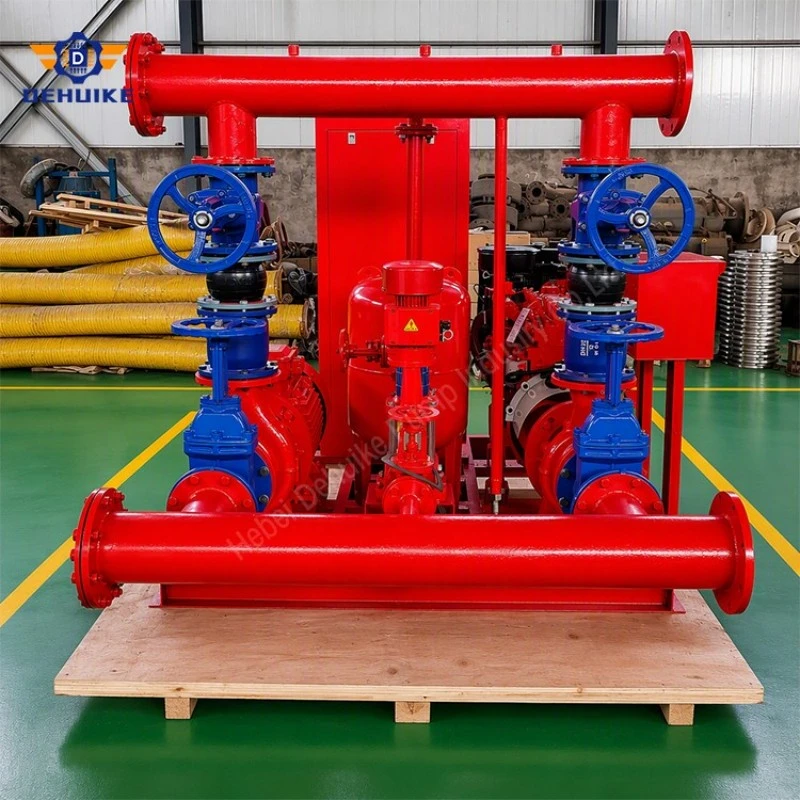
Two offers for the same model can differ by a third of the price and still be honest, because the scope differs. These assemblies are put together from items that are easy to omit and costly to add once the room is built.
Table 1 Items in a split case fire pump set and the questions they raise
|
Item |
Job in the assembly |
What buyers forget to confirm |
|
Pump end and motor |
Meet the duty and hold it across the curve |
Sizing basis, voltage, frequency, enclosure |
|
Pedestal and coupling |
Keep alignment under load and vibration |
Base type, grout provision, guard |
|
Starting panel |
Bring the unit in, monitor, alarm |
Start method, transfer switch, remote signals |
|
Holding pump |
Keep standby pressure, limit main starts |
Setting range, separate control unit, isolation valves |
|
Relief valve |
Keep churn pressure off the pipe |
Sized for the unit, outlet route |
|
Stop valves |
Isolate the unit for service and testing |
Valve type, position, check valve location |
|
Test header and meter |
Measure full and overload flow safely |
Pipe size, drain path, calibration |
|
Instruments |
Read intake vacuum and delivery pressure |
Range, accuracy, spare ports |
|
Documentation |
Prove the duty and support acceptance |
Curve, drawings, test record, service manual |
The lowest price often covers a pump, a motor and a starting panel and nothing else. Relief valve, holding pump, test header and meter then return as variations. Ask every supplier for the same itemised list and compare line by line, not on the total at the bottom.
The Intake Side
Flooded intake is the arrangement to aim for. The tank level stands above the inlet, the run is short, and the pump has little work beyond moving water. A lift layout is possible, but only with a proper NPSH check at the highest flow the unit will see, not at the rated point.
NPSHr rises with flow, and the test takes the unit to 150%. A layout that is comfortable at 80 L/s can be marginal at 120. Check the margin at the high flow, at the lowest level the tank design allows, with the strainer half blocked. Those three conditions rarely meet on paper. They meet often enough in service.
Vortexing is a tank problem that looks like a pump problem. An inlet too near the surface, or too near a wall, draws air into the wheel. Outlet pressure drops, noise rises, vibration appears. An anti-vortex plate, more submergence or a shifted inlet usually fixes it, which means the tank drawing has to be reviewed with the pump drawing.
Air leaking past a flange gasket produces the same symptoms. A joint that seals under pressure can leak under vacuum. If the unit loses prime or runs rough only when the level falls, check the intake joint before blaming the impeller.
Controls and the Pressure-Holding Pump
Line pressure falling to the set point is what brings the unit in. From there it keeps running until a person stops it, since the fire may still be alight. Anyone raised on booster logic will find that odd, so say so at handover, not at the first alarm.
Small leaks and slow decay are the holding pump's business. It cuts in above the point that starts the main machine, and cuts out higher again. Fill and vent the network, then let pressure decay slowly and watch the order of events. Settings that overlap will wake the big unit for a dripping valve, which is precisely what the little one was fitted to avoid.
Testing needs a safe route for water. A header with sight glasses, or a calibrated meter, lets the operator measure churn, 100% and 150% without flooding the room. The discharge should reach a drain or leave the building, and that route belongs in the layout discussion.
A diesel driver brings fuel storage, battery charging, cooling water and a weekly run routine. It also adds weight and vibration to the base and the slab. An electric-only offer and a diesel offer for the same hydraulic duty are different products, not two prices for one machine.
Space, Access and Drainage
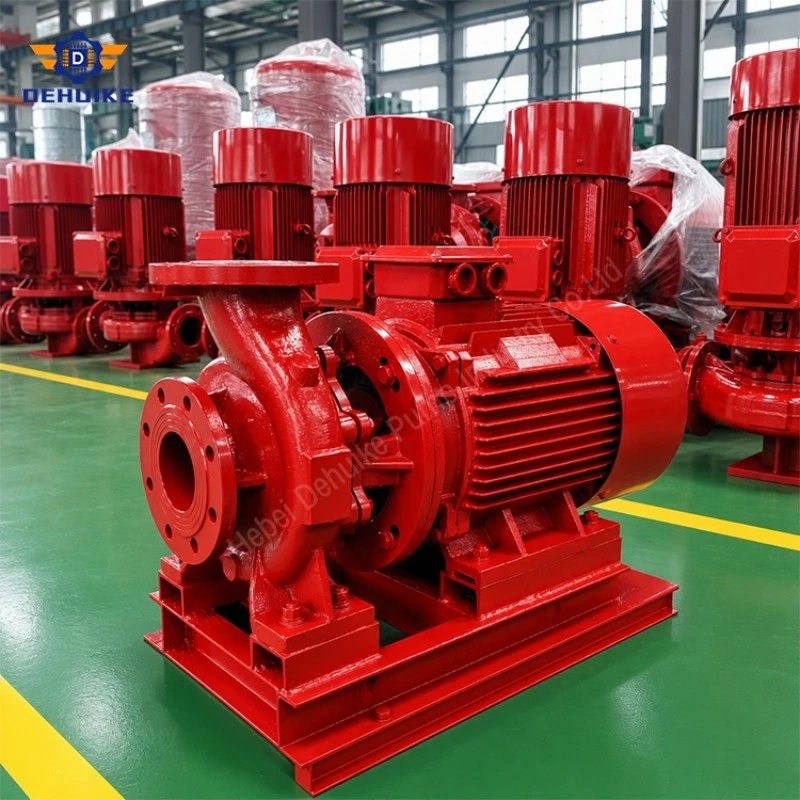
Length drives the room. Pump and driver sit end to end, and each end needs clearance of its own. Allow for the motor lifting beam, the top half of the housing when it is swung clear, and the shaft assembly when it is drawn out. A room sized to the baseplate alone will cost more to service than it saved to build.
Access belongs on the drawing. Isolation valves should be reachable without climbing on pipework. The control cabinet wants eye level and a dry position, away from the coupling. Drain and test connections need a path out of the room.
Ventilation and drainage get deferred and then cannot be retrofitted. A diesel set produces heat and exhaust. A leak, a relief discharge or a test run puts water on the floor. Decide where that water goes before the slab is poured.
FAQ
Why is the motor bigger than the power at the duty point?
Power rises as flow opens up, and the flow test reaches 150% of rated. The driver is sized so it is not overloaded anywhere on the tested curve.
Does it need a flooded intake?
It is the safer arrangement. A lift layout can work if NPSH is checked at maximum flow and minimum tank level, with intake losses included.
Why fit a small pressure-holding pump?
It covers small leaks and stops the main unit starting every time a valve drips. Its settings sit above the main unit's cut-in point.
Is a diesel driver available?
Yes. The offer then needs fuel tank, batteries, cooling and the weekly test routine, because those change the room and the service plan.

Hot Tags: split case fire pump set, China split case fire pump set manufacturers, suppliers, factory