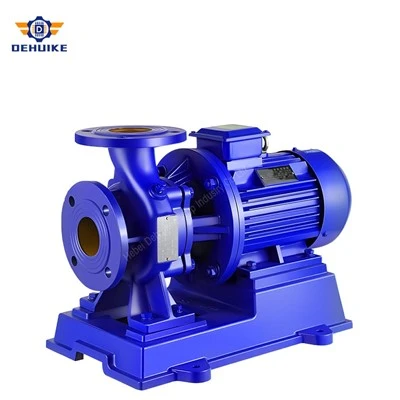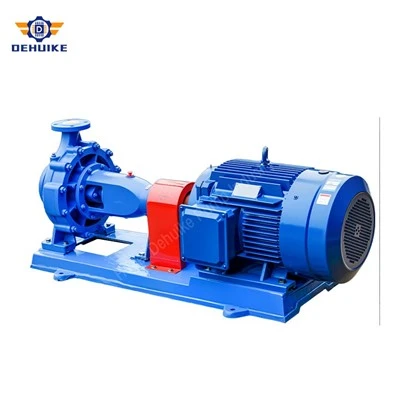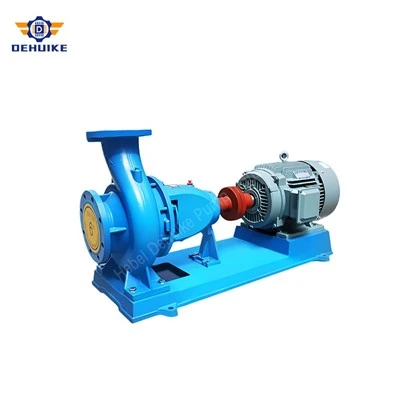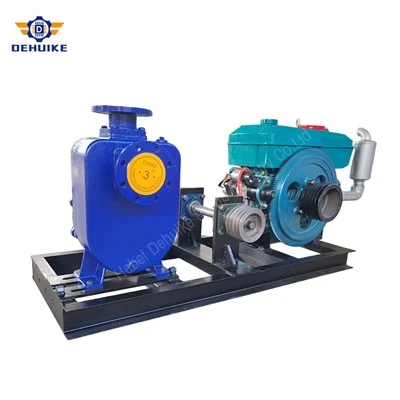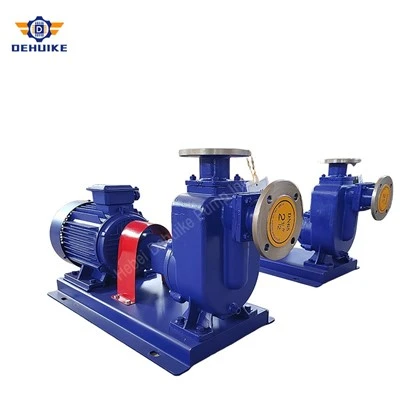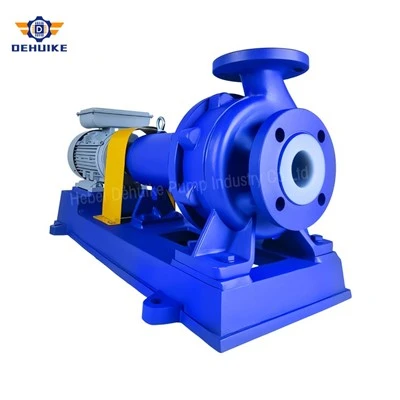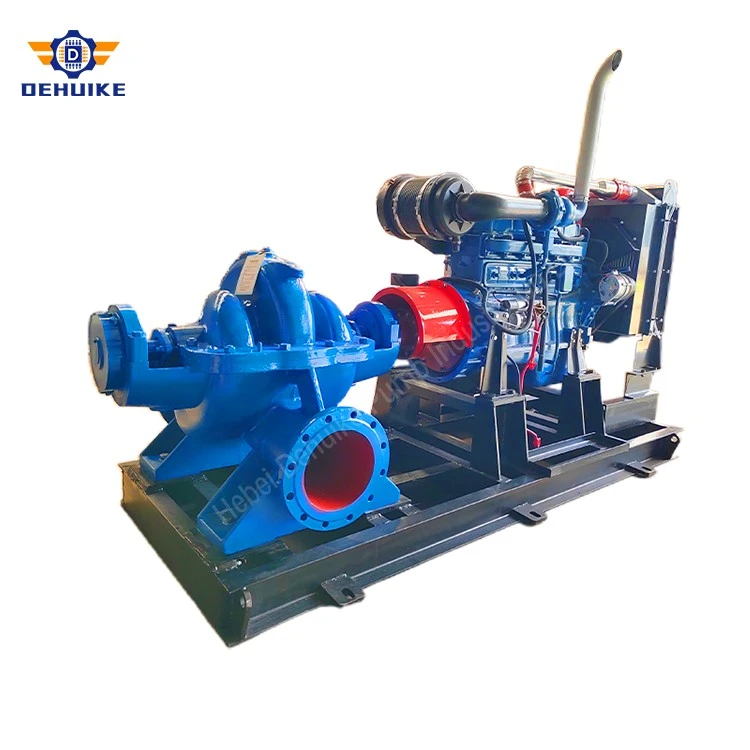
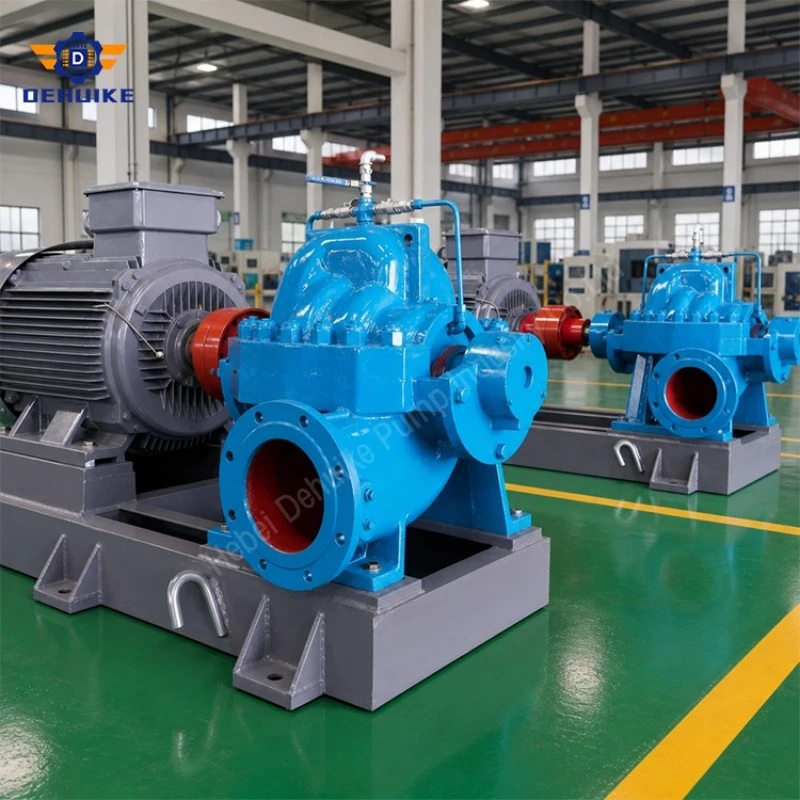
Hebei Dehuike Pump Industry Co., Ltd. is one of the most reliable manufacturers and suppliers of single stage double suction pump in China. With abundant experience, we are committed to providing high quality customized pumps with competitive price. Welcome to wholesale bulk single stage double suction pump for sale here from our factory. Also, pricelist is available.
Introduction
A double suction split case pump is normally chosen for the discharge side of its duty: the flow, the head, the efficiency, the pipe sizes. The suction side gets one number in the offer, NPSHr, and a line in the drawing. Then the station is built, the pump passes its acceptance test on a full sump, and eighteen months later someone opens the casing and finds the impeller eaten away on one side.
That is the ordinary shape of a cavitation failure. It is not a manufacturing defect, and it rarely appears on the day of commissioning, because commissioning happens with a high water level and a clean strainer. It appears later: at low water, in summer, after a zone was added and the pump was left running beyond its duty.
This article is about that side of the machine: what the number means, how to calculate the available margin before ordering, why the double-entry layout helps and where it does not, and how to read the evidence when something is already wrong.
What is actually happening in there
Water boils at a lower temperature when the pressure is lower, and inside a pump inlet the pressure is the lowest point in the whole system. Where local pressure falls below the vapour pressure of the liquid, small vapour cavities form on the low-pressure face of the impeller blades. They are carried along with the flow into a region of higher pressure and collapse there, in microseconds, with a jet of liquid hitting the metal surface at several hundred metres per second.
Two things follow. Metal is removed, and it is removed from a specific place: the suction side of the blade, close to the shroud on large machines, and often in a ring pattern around the eye. The second consequence is hydraulic: the cavities occupy space that should carry water, so the head developed drops and the flow through the pump falls away, even though the pump is still turning at full speed.
Sustained operation in that condition destroys an impeller in months rather than years, and takes the seal and the bearings with it, because the collapse is asymmetric and the radial loads shift. That is why the margin is worth calculating rather than discovering.
The arithmetic, done by hand
Available NPSH is the pressure energy left over at the pump inlet, expressed as a height of liquid, after everything the system has already taken away. For an open tank or sump it reads: atmospheric pressure head, minus the vapour pressure head of the liquid, minus the static lift from the water surface to the pump centreline, minus the friction losses in the suction pipe and fittings at the design flow.
Take a station with the pump centreline 3 m above the lowest water level, a suction line losing 0.8 m at design flow, water at 25 °C, and the site at 500 m above sea level. Atmospheric head at that altitude is about 9.5 m; the vapour pressure head of water at 25 °C is 0.32 m. Available NPSH = 9.5 - 0.32 - 3 - 0.8 = 5.4 m.
Now set that against a 300 mm machine rated at 58 m, whose published NPSHr is 5.5 m. The margin is negative on paper and the pump will cavitate the first summer the water level drops. It would have passed a commissioning test on a full sump with a margin of several metres, which is exactly how these failures survive acceptance.
Two cautions on the arithmetic. Friction losses rise with the square of flow, so the margin shrinks whenever the pump runs beyond its rated point, and a suction strainer that is half blocked adds a loss nobody measured. And the vapour pressure term is not fixed: it is the one component that changes dramatically with temperature.
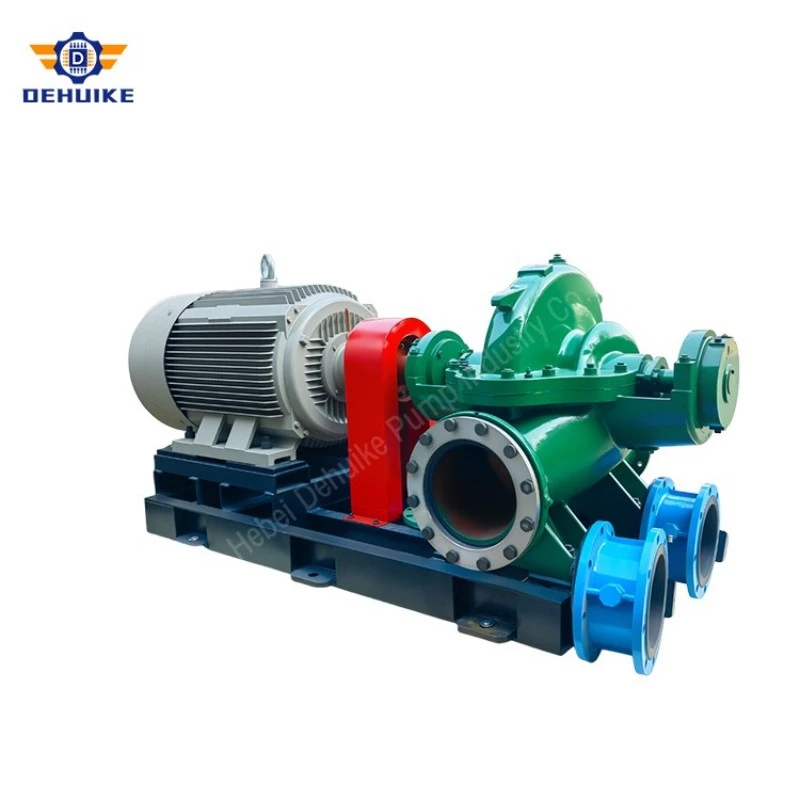
Table 1 Vapour pressure head of water, and what it takes out of the atmosphere
|
Water temperature |
20 °C |
40 °C |
60 °C |
80 °C |
100 °C |
|
Vapour pressure head |
0.24 m |
0.75 m |
2.03 m |
4.82 m |
10.33 m |
A cooling-water pump handling 70 °C water has 3.6 m of atmospheric head consumed before the pipework takes anything. A pump selected on cold-water figures and later put on a hot loop is a pump that will be blamed for a fault it was never sold to handle.
What the double-entry layout buys, and what it does not
The double suction impeller draws liquid into both sides of the rotor, so each eye carries half the flow. Inlet velocity is lower, the pressure drop on the blade is smaller, and NPSHr comes out better than a single-entry pump of the same duty. That is a real hydraulic benefit, and one reason these machines suit high-flow duties on shallow sumps.
The published figures across the range show the pattern clearly: NPSHr climbs with speed and with casing size, from 4.0 m on a 250 mm unit at 1,450 r/min to 12.0 m on the largest high-head model.
Table 2 Published NPSHr at rated points, selected models
|
Model |
Bore (mm) |
Speed (r/min) |
Rated head (m) |
NPSHr (m) |
|
250S65 |
250 |
1 450 |
65.1 |
4.0 |
|
150S78 |
150 |
2 900 |
78 |
5.0 |
|
300S58 |
300 |
1 450 |
58 |
5.5 |
|
500S59 |
500 |
970 |
59 |
6.0 |
|
800S76 |
800 |
740 |
76 |
8.0 |
|
1200S85 |
1 200 |
745 |
85 |
12.0 |
The smaller, faster machine is not the friendlier one. The 150 mm unit at 2,900 r/min requires 5.0 m, while the 500 mm unit at 970 r/min requires 6.0 m for a similar flow and head, because its absolute flow is four times greater. Speed helps only when the comparison is made at equal flow.
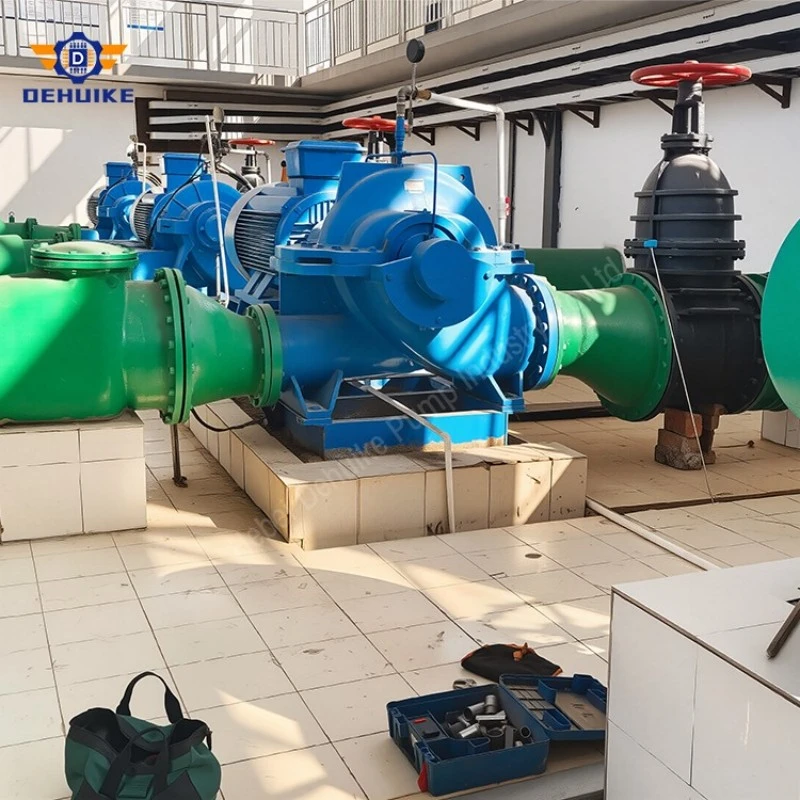
The layout has a limitation that the number hides. Two eyes need two equal supplies. Where the suction pipe approaches from one side and the inlet chamber is asymmetric, one eye receives less than the other, and the machine cavitates on that side first. The damage pattern then looks like a badly cast impeller rather than a system problem, and the supplier spends a year defending a casting that was never at fault.
The sump is part of the pump
Below a certain water level, a sump stops delivering water and starts delivering a mixture. A free surface vortex forms over the inlet, air is drawn down the pipe, and the pump loses head in a way that looks like cavitation and is not. Air entrainment produces a hard, irregular knocking, fluctuating gauge readings and a flow that wanders; true cavitation produces a continuous gravel-like crackle that stops when flow is reduced.
The geometry that prevents it is unglamorous: submergence below the low-water line, distance to walls and floor, an approach velocity low enough to keep the surface flat, and a bell or baffle where the flow turns. What usually happens is a sump built to fit the excavation, the pump chosen afterwards, and the last 300 mm of water declared unusable.
For a double-entry machine the geometry matters twice, because the inlet has to feed both sides evenly. A bent suction line that leaves the flow swirling as it enters the casing is the most common cause of one-sided damage on these pumps. If the pipework cannot be straightened, a flow straightener or a longer inlet section is far cheaper than an impeller replacement every second year.
Reading the evidence before opening the casing
Three symptoms point at the suction, and they can be separated at the panel without tools.
The noise. Cavitation crackles like gravel poured onto metal, continuously, and it fades when the discharge valve is partly closed or the water level rises. Air entrainment knocks irregularly and comes and goes with the surface. Recirculation at low flow rasps and appears only when the flow is throttled hard.
The numbers. A cavitating pump loses head and flow together while drawing slightly less power, because less liquid is being moved. If flow falls but power stays where it was, look at the discharge side and the clearances instead.
The damage. Pitting on the suction face of the blade, concentrated near the shroud or in a ring around the eye, is cavitation. Smooth erosion of the whole impeller and casing, with the paint intact, is abrasive wear. A single damaged eye points at uneven inlet flow rather than at insufficient NPSH.
Compare the measured duty with the approved curve at more than one flow. A pump that meets its curve at the rated point but falls away at higher flow is showing that its NPSHr margin is being consumed by the square of the flow, which is a system issue that no impeller change will fix.
Fixing it in cost order
he cheapest remedies come first, and they are usually the ones that were available at the design stage.
Raise the water level. Often a matter of a control setpoint or a weir height. Every 100 mm of extra submergence is 100 mm of extra NPSH available, and it costs nothing.
Clean the suction path. A blocked strainer, a partly closed valve or a foreign object at the bell can account for a metre of loss that was never in the calculation.
Reduce the losses in the pipe. One size larger on the suction line, one elbow removed, or a longer straight run into the inlet will each buy a few tenths of a metre, and the pipe is often the cheapest item in the station.
Slow the machine down. NPSHr falls roughly with the square of speed while the duty head falls too, so a drive that trims the speed during low-water periods can hold the pump out of cavitation without changing the hardware.
Trim the impeller or change the pump. The expensive answers, and the correct ones when the duty itself is wrong. A smaller impeller reduces the flow and the NPSHr demand together; a different family may reduce the required margin more effectively than any pipe change.
The wrong answer is to accept a noisy pump because it has always been noisy. A machine that has cavitated for three years carries an impeller, a seal and a set of bearings that are all closer to replacement than the maintenance plan assumes.
FAQ
Q: The pump passed its test, so how can it be cavitating?
A: Because the test ran at a high water level, a clean strainer and the rated flow. Cavitation appears at low water, at high flow, or with a dirty suction. Ask for the NPSH available at the worst credible condition, not at the commissioning condition.
Q: Is a double suction pump immune because it has two inlets?
A: No. It has a lower NPSHr than a single-entry machine of the same duty, but the margin still has to be calculated, and an asymmetric inlet can make one eye cavitate while the other is healthy.
Q: Can a variable-speed drive solve a cavitation problem?
A: It can hold the pump out of cavitation during low-water periods, since NPSHr falls as speed comes down. It will not fix a sump that draws air, and it will not recover an impeller that has already lost metal.
Q:How much margin should be left?
A:The figure comes from the project specification and the applicable standard rather than from the pump supplier. What matters commercially is that the calculation is written down, uses the worst water level and the maximum flow, and is checked against NPSHr at that same flow.
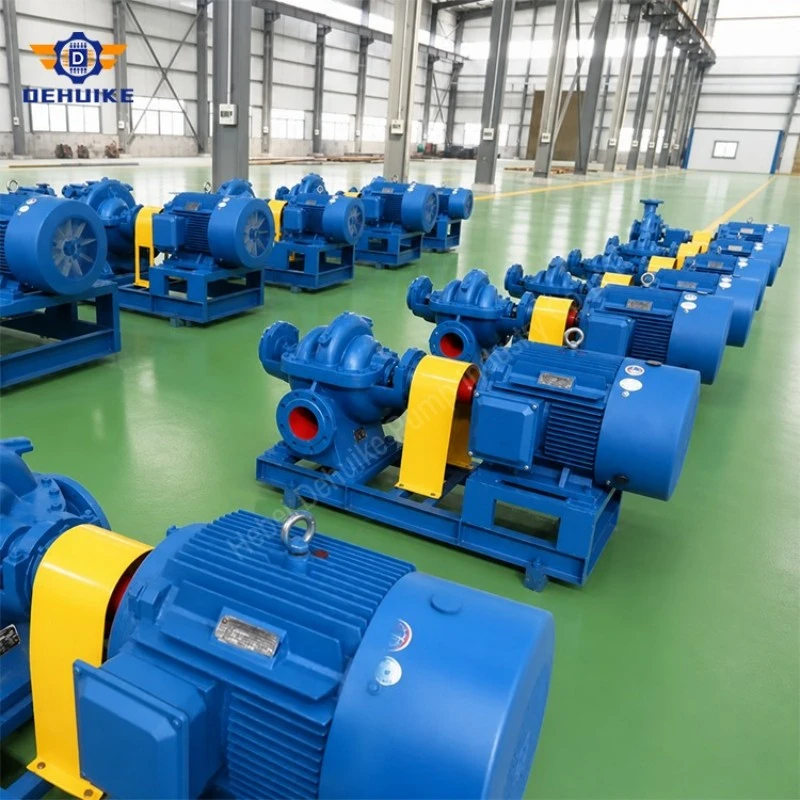
Dehuike Pump Industry manufactures the double suction split case range from 150 to 800 mm bore, covering flows to 12,240 m³/h, with the Sh and S designations, trimmed impeller versions and slow-speed variants available from the same casting family. The company works to ISO quality management system certification, has more than forty years of pump manufacturing behind it, over thirty product series and customers in more than ninety countries. Send the duty point and the system curve, and the proposal will quote specific energy at that point rather than a catalogue maximum.

Hot Tags: single stage double suction pump, China single stage double suction pump manufacturers, suppliers, factory