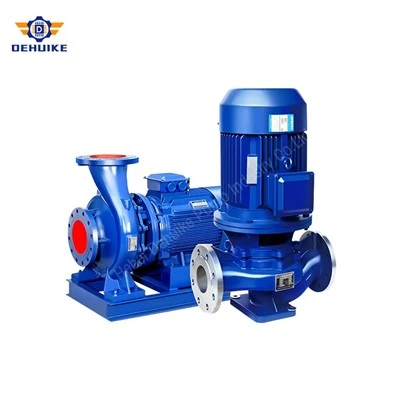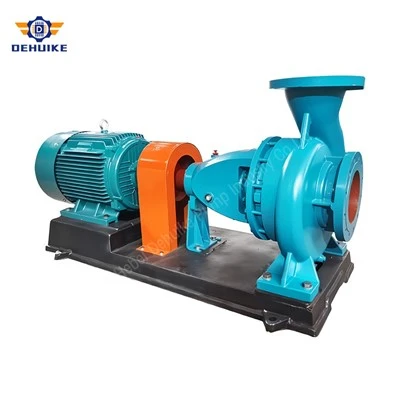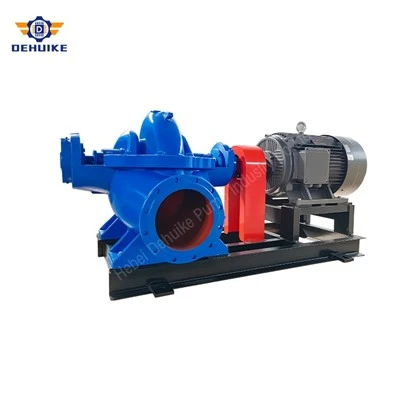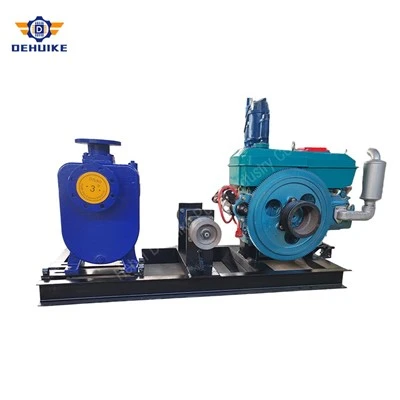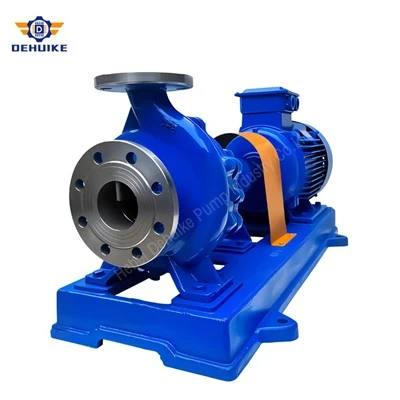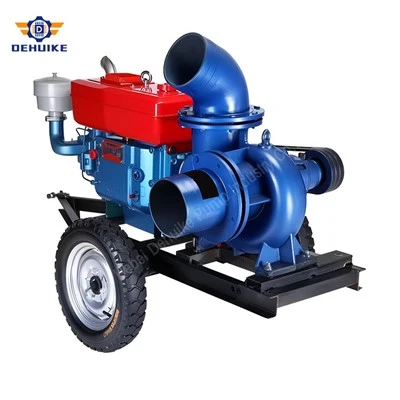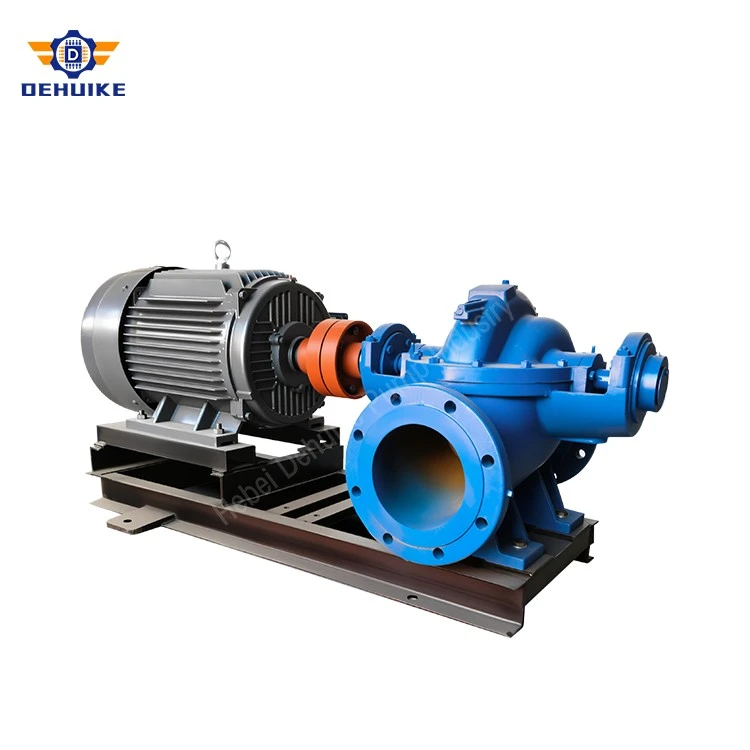
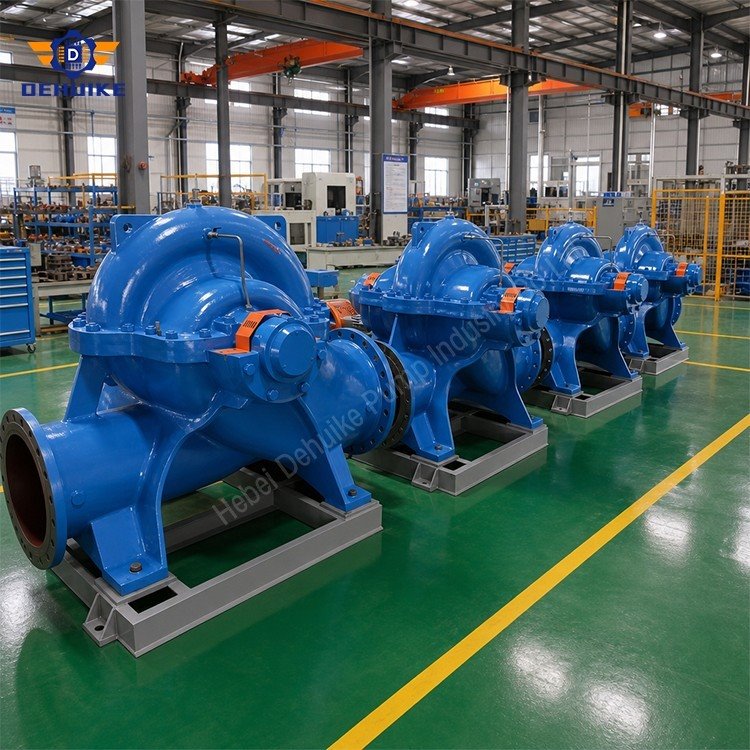
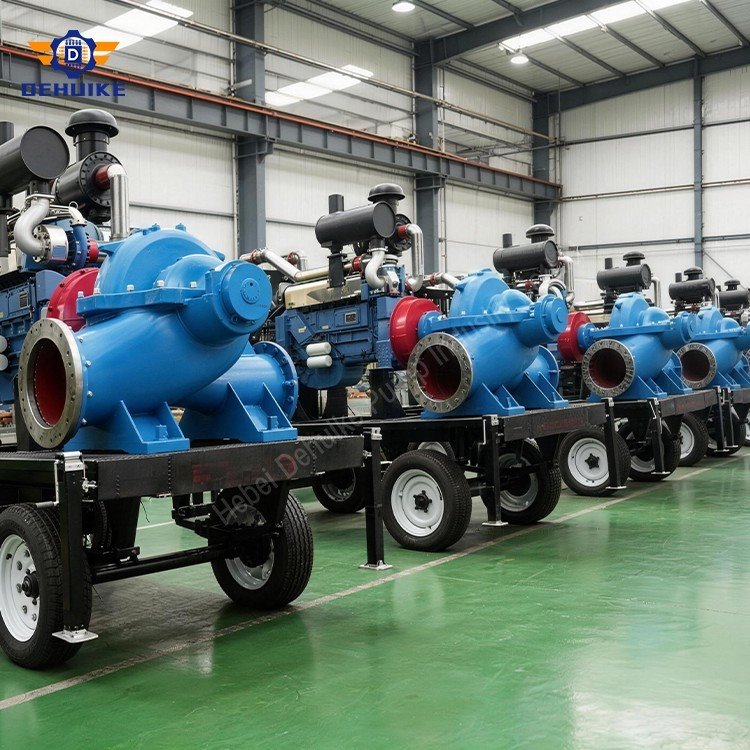
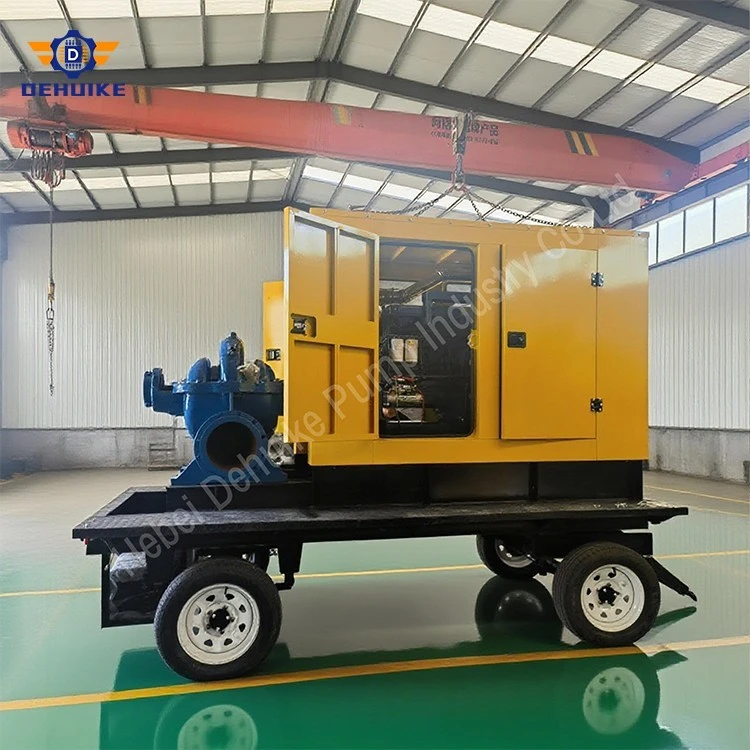
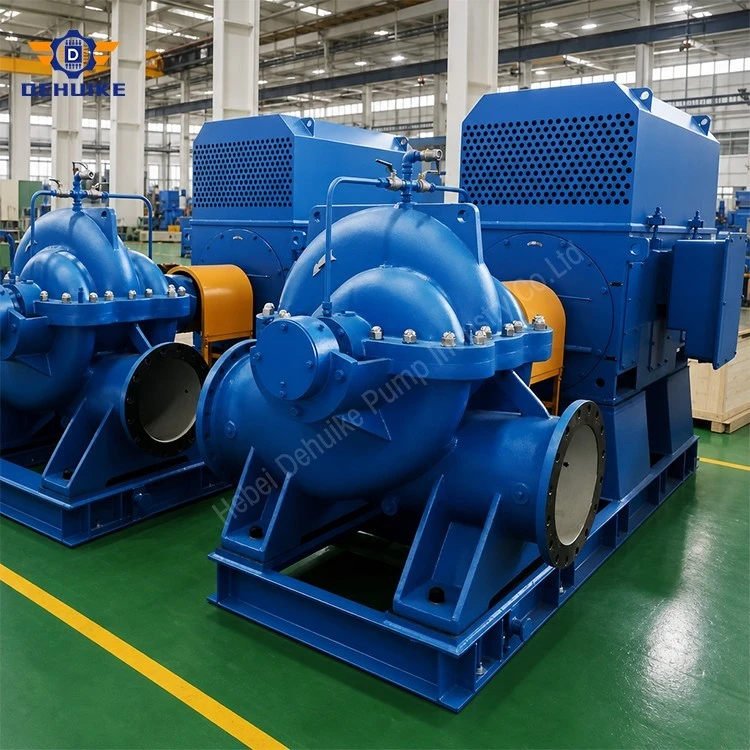
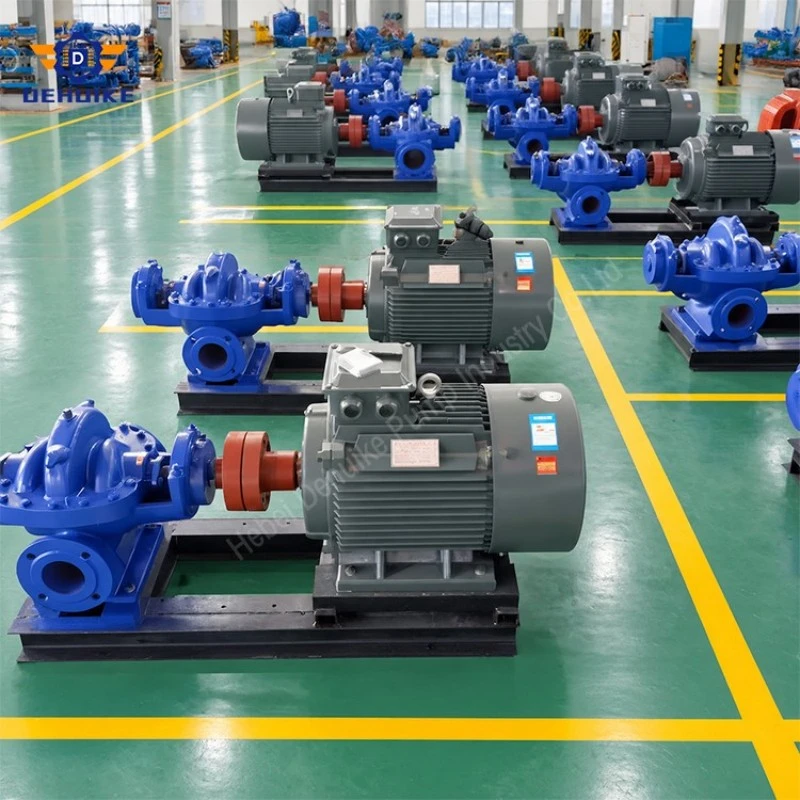
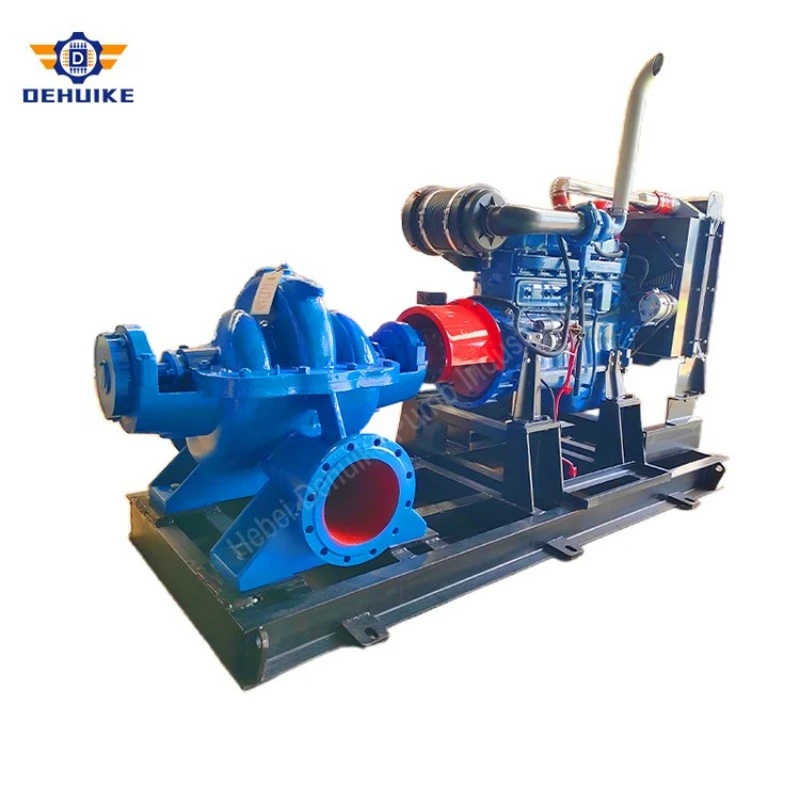
Hebei Dehuike Pump Industry Co., Ltd. is one of the most reliable manufacturers and suppliers of horizontal double suction centrifugal pump in China. With abundant experience, we are committed to providing high quality customized pumps with competitive price. Welcome to wholesale bulk horizontal double suction centrifugal pump for sale here from our factory. Also, pricelist is available.
Two Inlets, One Reason
On a single-entry wheel, full outlet pressure presses on the front face while inlet pressure sits behind it. The gap between those two acts on the annulus bounded by the outer diameter and the shaft.
With a 520 mm runner and a 140 mm hub, that ring measures 0.197 m2. At 32 m, about 314 kPa, the load reaches 61.9 kN. Six tonnes of axial force is not impossible to carry, but every bearing, thrust block and shaft diameter downstream of that face grows to suit it.
Feed both sides and the pressure cancels. What is left comes from casting variation and the gap at the wear rings, and it is measured in hundreds of newtons. This is the practical argument for the twin-eye layout, and it holds whether the water is cooling, boiler feed or raw river supply.
A second benefit follows from the same geometry. Each eye carries half the volume, so inlet velocity per eye is roughly half of what a single-entry wheel of the same diameter would see. Lower inlet speed means a smaller NPSH requirement, which buys margin in a shallow basin.
The Suction Margin, Written at Its Worst
Centreline 3.0 m under the low-water mark. Line loss 1.8 m at design flow. Water at 30 °C, vapour pressure 4.25 kPa, which is 0.43 m of column.
At sea level: 10.2 minus 0.43 plus 3.0 minus 1.8 leaves 10.97 m. Against a requirement of 4.2 m that is a 6.8 m cushion. Comfortable, and misleading if left at that.
Run the same sum at 40 °C and at the dry-season level. Vapour pressure rises to 0.75 m, the static term can fall by a metre, and the cushion is suddenly 5 m. Still workable, but the number has moved, and nobody checked it because the design case looked safe. A pump that cavitates twice a decade still eats a runner.
Changing the Duty Without Changing the Plant
Cooling loads shrink when a line is mothballed, and they grow when a new user is tied in. Two adjustments are open, and both follow geometry.
Trimming the wheel cuts diameter: volume with diameter, lift with its square, power with its cube. From 520 mm to 500 mm, a 3.8% cut, the result is 2,308 m3/h at 29.6 m and 216 kW at the shaft.
Slowing the shaft uses the same relations around a different variable. At 1,180 r/min the original wheel gives 1,953 m3/h at 21.2 m and 131 kW.
Table 1 Three routes to a smaller duty from one 520 mm wheel
|
Route |
Flow (m3/h) |
Head (m) |
Shaft power (kW) |
What it costs |
|
As supplied, 1,450 r/min |
2,400 |
32.0 |
243 |
Reference |
|
Machined to 500 mm, 1,450 r/min |
2,308 |
29.6 |
216 |
Permanent, no drive change |
|
1,180 r/min, wheel unchanged |
1,953 |
21.2 |
131 |
Needs a variable speed drive and a suitable motor |
A trim is cheap and irreversible. Speed is flexible and needs hardware. Neither option fixes a unit picked two sizes big: at half flow the wheel recirculates internally, and the vibration that results belongs to the installation, not to the published curve.
What the Split Casing Buys, and What It Charges
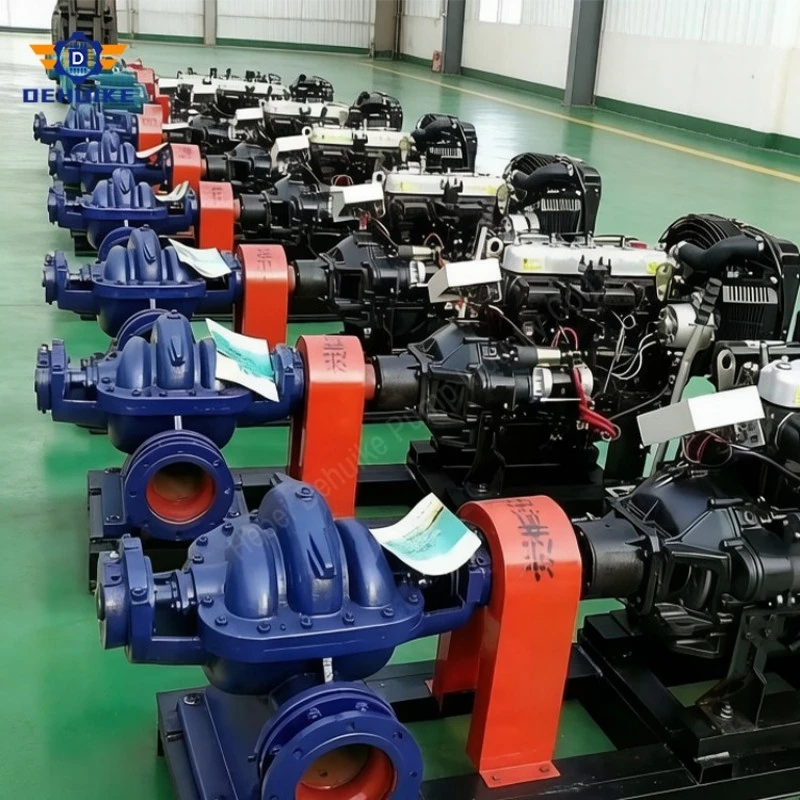
The housing is cut at shaft level. Lift the upper half and the wheel, both wear rings, the shaft and the bearing housings come into view, with the pipes still attached. For a plant that inspects every year, that is crane time and gasket stock saved.
It also demands care. The upper half of a machine this size weighs several hundred kilograms; the lift needs a rated sling and a hook with a real capacity, not an estimate from memory. The joint face has to be wiped dry, the gasket replaced rather than reused, and the bolts run up in a cross pattern over two or three passes to the maker's figure.
Once shut, spin the shaft by hand and check coupling alignment again. A casing that has been opened and shut rarely returns to exactly the position it left, and the alignment from last year is not the alignment that exists now.
Bearing Life Is a Formula, Not a Promise
Take a bearing with a dynamic capacity of 118 kN carrying 8.5 kN. The ratio is 13.9, its cube 2,684, and at 1,450 r/min the L10 life lands near 30,800 hours.
Read that correctly: at 30,800 hours, one bearing in ten will have failed. It assumes clean oil, correct preload and no pipe strain pulling the housing out of line. Plants that skip oil changes and never take a vibration reading get considerably less.
Packing or a Mechanical Seal
A packed gland leaks on purpose, 40 to 60 drops a minute, and that leak is what keeps the packing alive. It is forgiving, cheap and repairable with hand tools, and it leaves a drip tray to deal with.
A mechanical seal leaks almost nothing and needs no flushing water, which suits a plant room that must stay dry. It is far less tolerant: a few seconds of dry running, a worn face or a badly set spring finishes it.
On a loop that runs continuously, the water lost through packing is small in cost. What usually decides the question is the skill available on the night shift.
Readings to Take Before Sign-Off
Log flow, inlet pressure, outlet pressure, power and vibration at the duty. Compare the head with the 32 m that was specified; a gap of more than a few percent usually traces to a throttled valve, a fouled exchanger or a gauge on the wrong range before it traces to the pump.
Vibration on this class of machine should stay below 2.8 mm/s rms, read at the bearing housing in two directions. A figure that climbs over the first month points at alignment, pipe strain or a part-closed valve, not at the bearings.
Hold it two hours at the specified condition, then once at 110% of flow if the loop allows. A cooling system that never reaches its maximum demand during the test will reach it on the hottest day of the year.
Installation Risk Points Often Missed
Suction geometry is a frequent source of trouble in high-volume pump stations. A narrow suction pipe, sudden elbow, air pocket, vortex risk or poorly positioned valve can reduce available suction margin. The pump table gives NPSHr; it does not prove that the installed arrangement will provide enough available NPSH.
Pipe load is another practical issue. Large suction and discharge lines should be supported independently so that flange forces are not transferred into the casing. Foundation level, base grouting, coupling alignment and thermal or settlement movement should be checked before commissioning.
For a Horizontal Double Suction Centrifugal Pump, overhead access must be designed before the pump is installed. If a wall, pipe bridge, cable tray or roof beam blocks upper casing removal, the benefit of the horizontal split arrangement is weakened. Maintenance planning should be part of the layout review, not an afterthought
Configuration Items to Confirm
Casing and impeller materials for the confirmed water quality.
Sealing arrangement, gland service needs and any leakage management requirement.
Flange standard, nozzle orientation and connection dimensions.
Motor voltage, frequency, enclosure, efficiency class and starting method.
Coupling, guard, baseplate, anchor bolt and instrument requirements.
Inspection, testing, third-party witness, certificate and document language requirements.
Packing, preservation, spare parts and shipment terms for the destination market.
Pump Station Design Checklist for Lower-Risk Procurement
Before a pump is purchased, the station should be described as a working environment rather than a single duty number. Record the source arrangement, the lowest reliable water level, the highest discharge requirement, the planned operating hours and the way the operator will isolate the unit for inspection. This type of checklist gives the supplier a practical view of the site and reduces the risk of selecting a pump only from a short model label.
For a Horizontal Double Suction Centrifugal Pump, the suction side deserves early attention because the inlet carries a large volume of water. Long horizontal suction runs, sudden diameter changes, tight elbows near the nozzle, partially closed valves and poorly vented high points can all reduce the quality of water entering the casing. The enquiry should therefore include a simple suction sketch or a list of fittings, not only the pipe diameter.
The discharge side also influences the operating point. A long rising main, several control valves, a throttling device, a strainer, a flow meter or a branch network may create more resistance than expected. If the head calculation is underestimated, the selected unit can operate away from the intended region. If the head is overestimated, the buyer may purchase a larger motor and pump set than the station really needs.
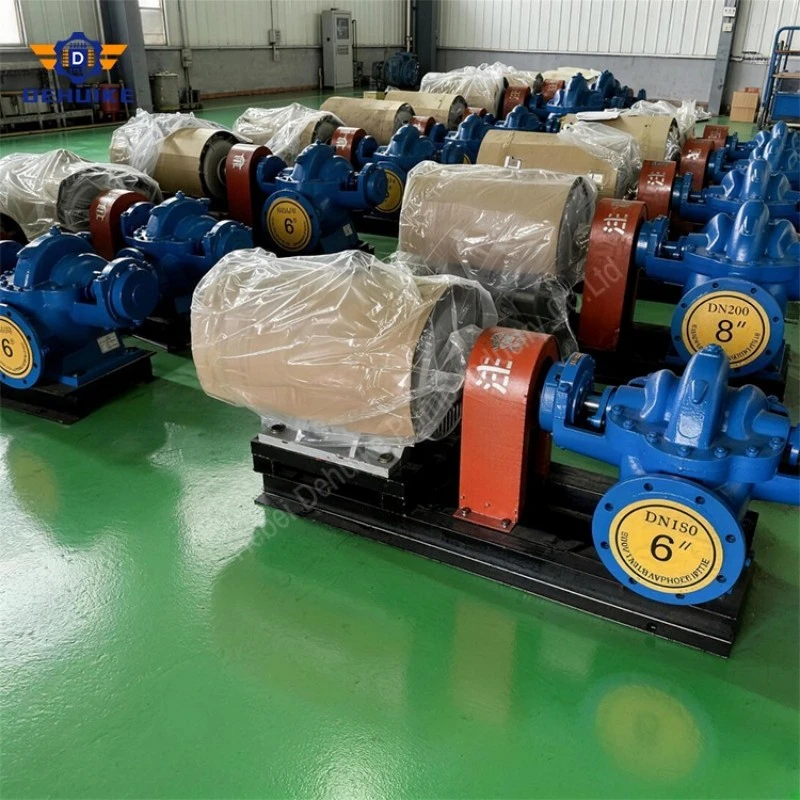
Maintenance planning should be reviewed at the same time as hydraulic selection. The upper casing needs a safe lifting path, but the surrounding pump room may include beams, cable trays, platforms, pipes or wall clearances that make access difficult. A buyer should check lifting height, crane reach, sling route, coupling access, bearing inspection space and drain arrangement before confirming the layout.
Documentation should be agreed before production. For export projects, the buyer may need dimensional drawings, curve information, packing list, inspection record, motor data, spare-part list or a language-specific document package. Stating these items during quotation is more reliable than adding them after the pump is already manufactured.
System-Based Differentiation From Other Water Pump Pages
This article is intentionally organized around the horizontal station problem instead of repeating a generic double-suction description. The main difference is the way the pump interacts with a large physical installation. A compact water pump page may focus on easy installation, but this product usually belongs to a civil, mechanical and electrical package where foundations, pipe anchors, lifting route, operating reserve and inspection records all matter.
The product should also be separated from a general split-case category page. A split-case phrase describes casing access, while this page emphasizes horizontal high-volume water duty, model-row integrity, suction margin and procurement communication. That difference is useful for buyers searching specifically for a Horizontal Double Suction Centrifugal Pump because their questions often involve station fit, driver size, suction reliability and service planning.
Compared with a cooling-water-only article, this content does not assume a plant circulation loop. Compared with an irrigation-only article, it does not assume a seasonal field demand pattern. Compared with a fire-water article, it avoids unverified statements about fire approval, listing or authority acceptance. The page stays broader, but it keeps the discussion grounded in measurable station data.
A buyer can use this structure as a technical enquiry template. The model table gives a starting point, while the surrounding sections explain which site facts must be supplied before the pump can be responsibly selected. This reduces duplicate wording and makes the article more useful for real procurement conversations.
Operation and Maintenance Planning After Installation
After installation, the operating team should create a baseline record. Useful baseline information includes normal inlet pressure, discharge pressure, flow estimate, motor current, bearing temperature, vibration observation, valve position, noise condition and any visible leakage around the sealing area. These records help the operator identify changes later, especially in stations that run for long periods.
Routine inspection should focus on changes rather than only calendar intervals. If the discharge pressure drops, the suction water level changes, the motor current rises or vibration becomes more noticeable, the system condition should be checked before assuming the pump itself is defective. Blocked strainers, air in the suction line, valve movement, pipeline leakage or fouling in connected equipment can all shift the operating point.
Planned shutdown work should be prepared with safety isolation and lifting arrangements. The maintenance team should know how the upper casing will be lifted, where removed components will be placed, how the coupling will be checked and how the unit will be realigned. Keeping these details in the station maintenance file improves repeatability and reduces unnecessary downtime.
Spare-part planning should follow the confirmed model and serial information. Generic part names are not enough for long-term support because impeller size, shaft details, bearing arrangement and sealing configuration may vary by order. The buyer should keep the final technical file, quotation scope and shipment records together for future replacement work.
FAQ
What is a Horizontal Double Suction Centrifugal Pump?
It is a horizontal centrifugal pump in which water enters both sides of the impeller. A Horizontal Double Suction Centrifugal Pump is commonly evaluated for clean-water duties that require high flow, a single-stage hydraulic layout and practical access to internal components.
Which models are shown in the data table?
The table includes 8Sh-13 / 200S42, 10Sh-9 / 250S39, 14Sh-19 / 350S26, 24SA-10 / 20Sh-9 / 600S75 and 40Sh-B / 1000S46 at their listed design points.
What capacity range is represented here?
The five selected examples range from 288 to 8,250 m3/h. This is a selected reference set and should not be treated as the complete product-family range.
What total head range is displayed?
The listed design heads range from 26 to 71 m. The actual operating head depends on the full pump curve and the installed system curve.
Why does NPSH need separate checking?
NPSHr is the pump requirement at a stated duty. The station must provide enough NPSH available after water level, temperature, elevation, suction-pipe geometry and inlet losses are considered.
Can this pump be used for chemical or seawater service?
The available performance data does not confirm material grade, corrosion resistance, seal type or temperature limit. Liquid composition and service conditions must be reviewed before such a duty is accepted.
Is a model code enough for replacement?
No. Replacement selection should compare the old duty, measured operating data, nozzle position, foundation dimensions, driver details, pipe loads and service access with the proposed unit.
What should I send for a quotation?
Send flow, total dynamic head, water details, temperature, suction condition, pipe information, site elevation, voltage and frequency, operating schedule, destination, requested standards and document requirements.

Hot Tags: horizontal double suction centrifugal pump, China horizontal double suction centrifugal pump manufacturers, suppliers, factory