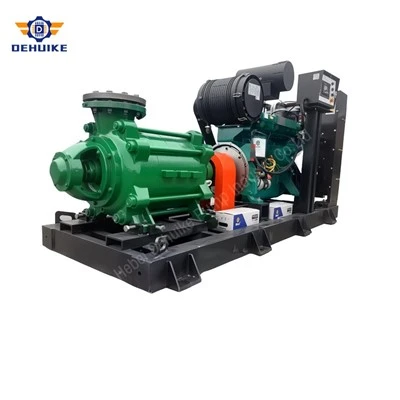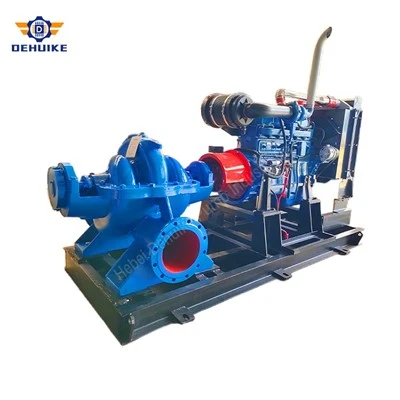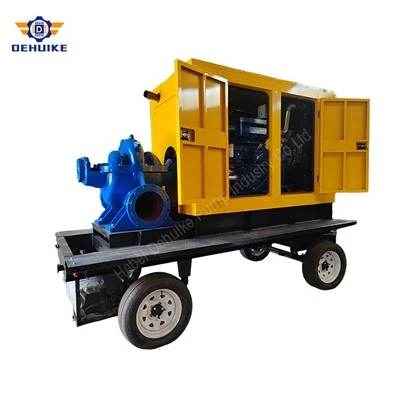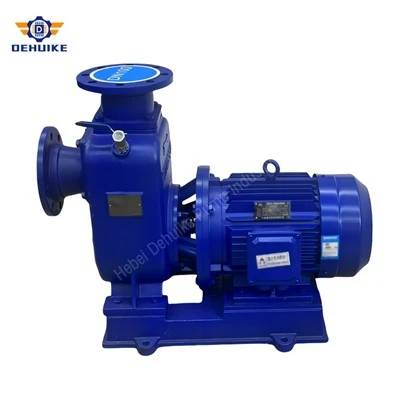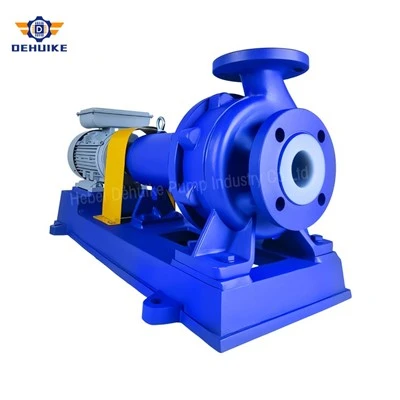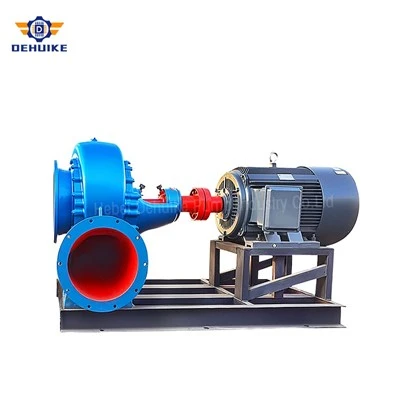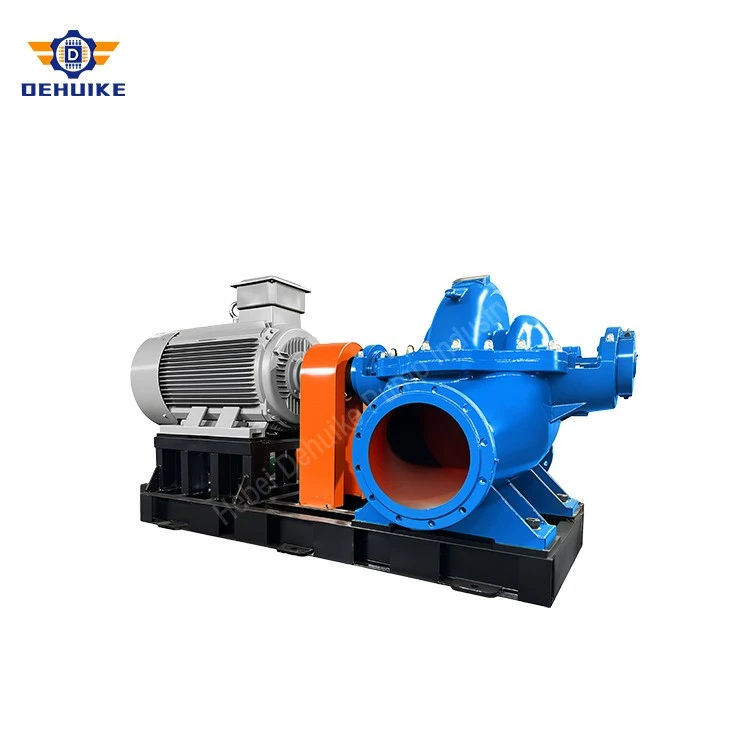
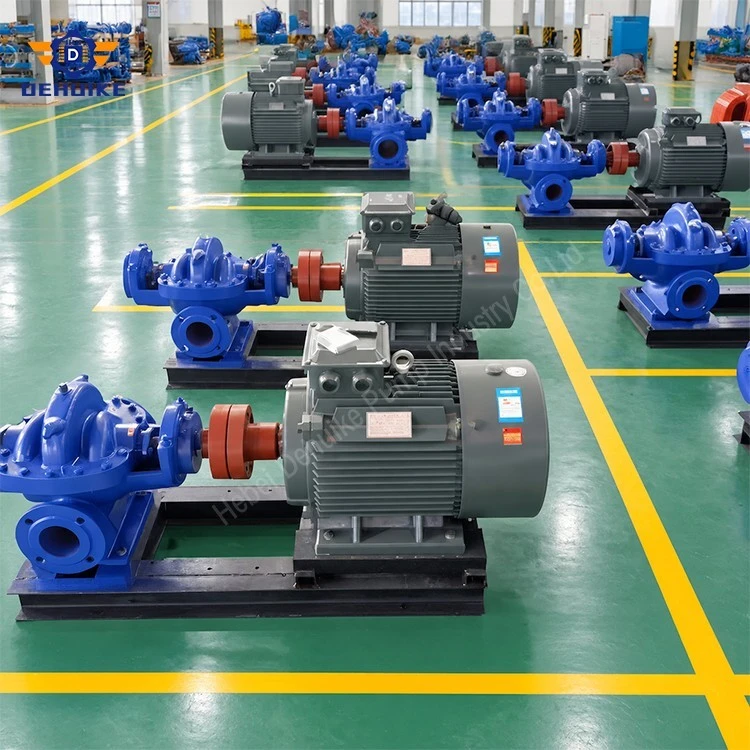
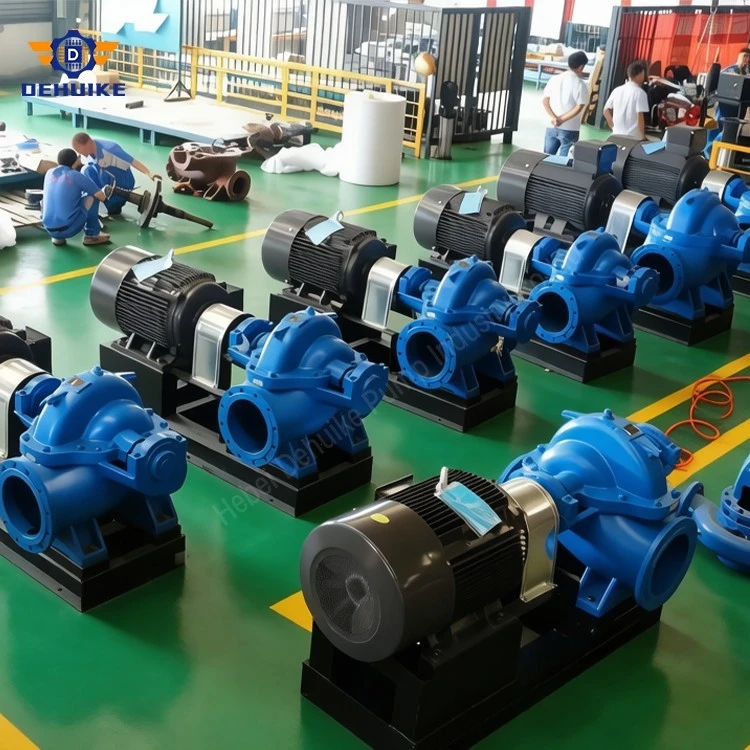
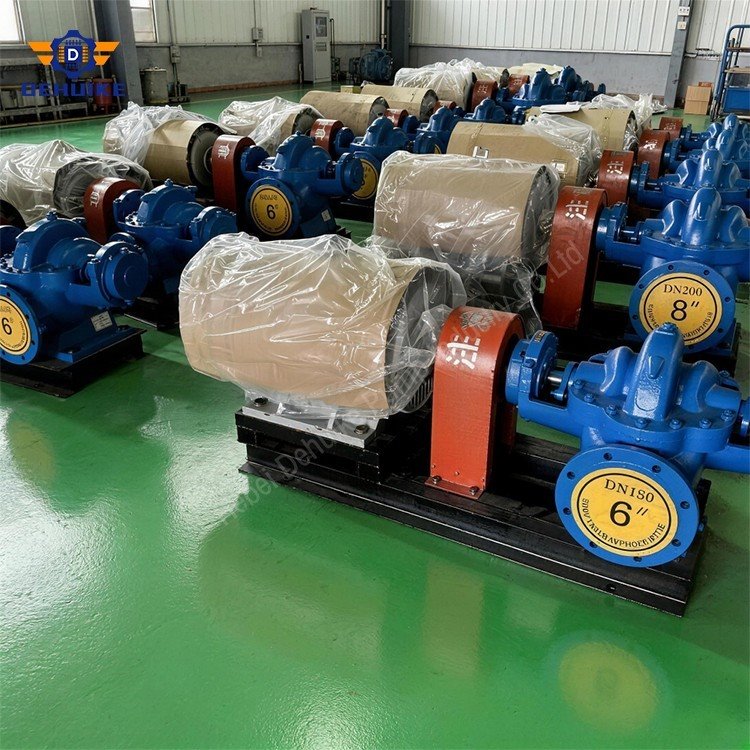
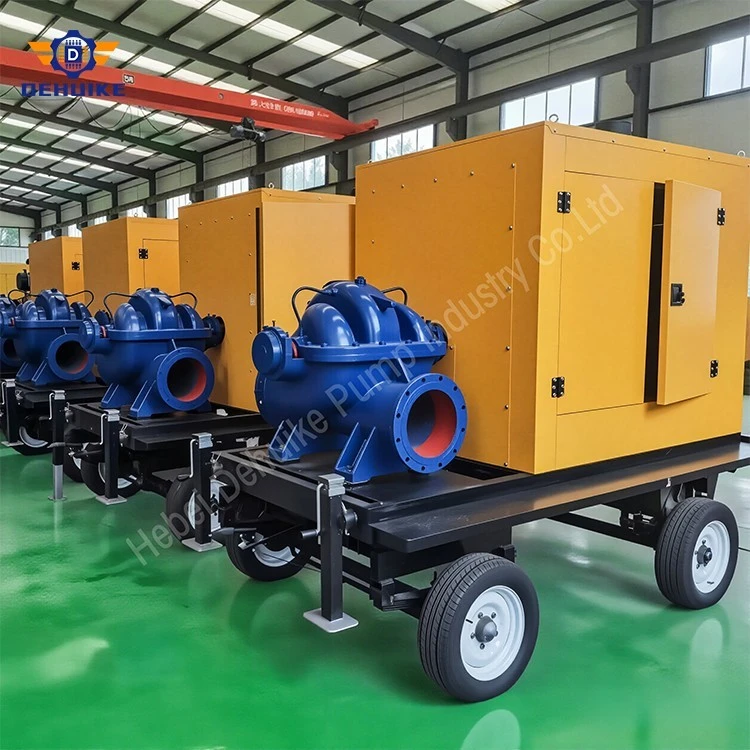
Hebei Dehuike Pump Industry Co., Ltd. is one of the most reliable manufacturers and suppliers of double entry centrifugal pump in China. With abundant experience, we are committed to providing high quality customized pumps with competitive price. Welcome to wholesale bulk double entry centrifugal pump for sale here from our factory. Also, pricelist is available.
The problem this pump type exists to solve
Somewhere in most water systems there is a duty a normal end-suction pump cannot reach without becoming awkward: a few thousand cubic metres an hour, 30 to 60 metres of head, and a suction side already marginal because the wet well is old and the water level moves.
Push a single-entry impeller into that duty and two things happen. Axial thrust grows, so bearings and shaft grow with it. Inlet velocity doubles through one eye, so the pump asks for net positive suction head it does not have. The double suction split case pump answers both with geometry rather than brute force.
The short answer
Water enters the impeller on both sides, so axial thrust largely cancels and the rotor runs on smaller bearings than a single-entry pump of the same duty.
Half the flow passes through each eye, lowering inlet velocity and usually improving suction behaviour at the same flow.
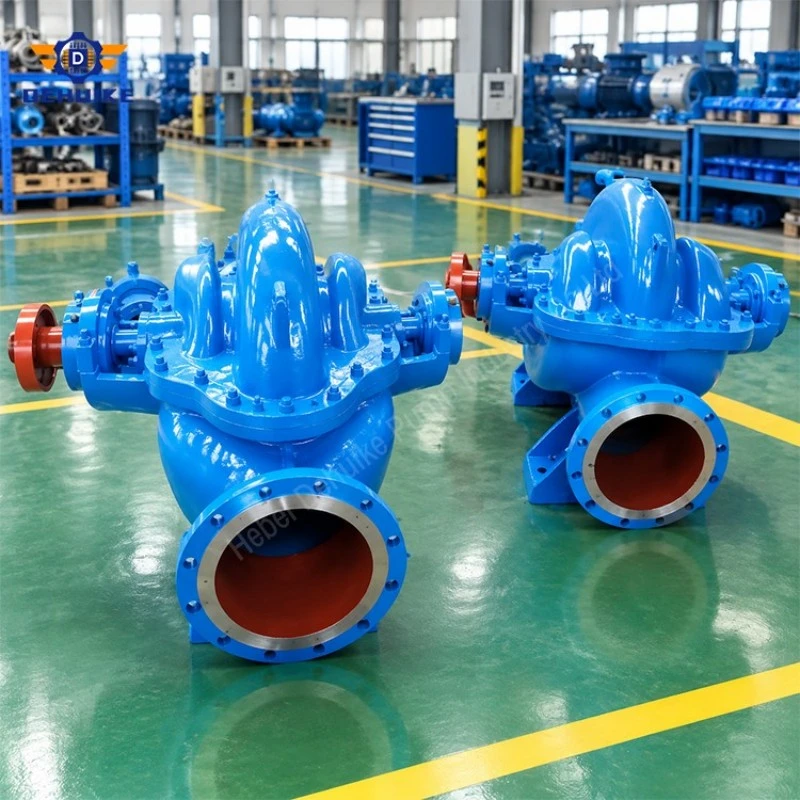
The casing splits along the shaft centreline, so the top half comes off and the rotor comes out with the pipework still connected.
Range here: 144 to 12,240 m³/h, heads 13 to 112 m, motors 37 to 3,450 kW, efficiencies 69 to 92 percent.
It is the wrong pump for low flows, dirty water, or a cramped pump room. Section 4 explains why.
What double suction actually changes
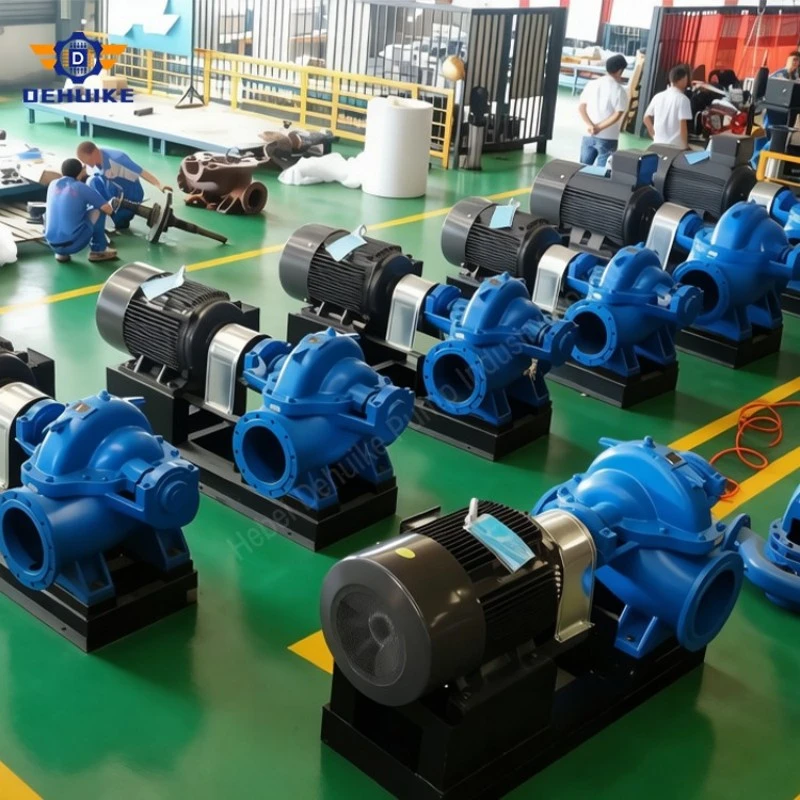
A double-entry impeller has two suction eyes facing opposite directions and a common discharge volute. Liquid arrives from a single nozzle and enters both sides of the impeller, so the two inlet streams push in opposite directions along the shaft and the axial hydraulic force largely cancels. The residual thrust is small enough that the bearing set can be modest.
The suction benefit is less obvious but matters more in upgrades. For the same total flow, each eye sees roughly half of it, so velocity through the eye drops and the NPSH requirement comes out lower than a single-suction impeller sized for the same duty.
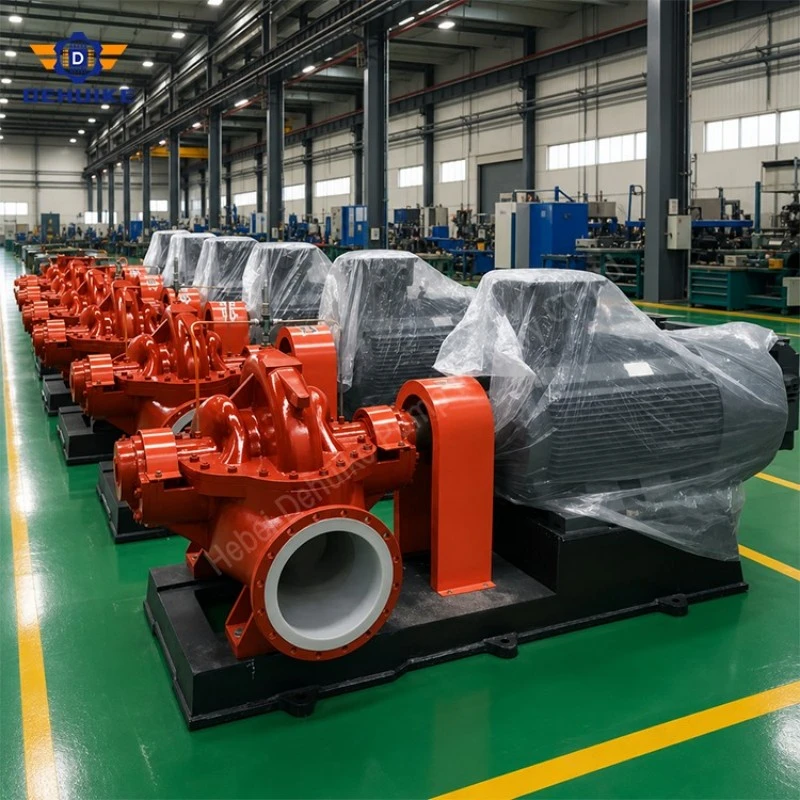
The split casing is a maintenance decision, not a hydraulic one. The casing is divided horizontally at the shaft centreline, so lifting the top half exposes the rotor, seals and bearings with the piping still connected. On a pump weighing nearly three tonnes, that is the difference between a planned day with a crane and a week of pipe work.
What you pay for it: more casing to cast and machine, two sealing paths instead of one, a heavier footprint, and a price that only makes sense once the flow gets large.
Where this type is the wrong answer
Honesty saves rework. A double suction split case pump is poor value in these situations:
Low flow with high head. A 170 m³/h duty at 47 m is served by a small single-entry pump that costs less, weighs less and fits in a corner. This family starts at 37 kW in the published table.
Solids in the water. Standard builds here are for clean or only lightly turbid water. Grit and fibres belong to a different hydraulic and a different material specification.
A pump room with no head room. Removing the upper casing needs vertical clearance above the unit and space for a crane hook. Retrofitting into a room built for a vertical turbine can be impossible.
Anybody who needs the pump next month. Large cast casings and big motors are made to order.
Seawater, chemical duty and high temperature are not automatically excluded, but they cannot be answered from a performance table either. Those need a material and sealing review against the actual liquid.
Sizing, in the order that avoids rework
Start with the duty, not the model name. Four numbers, in this order:
Flow. Use the design demand plus whatever margin the network owner actually wants, and write the margin down so nobody adds it twice. A station specified for 800 m³/h that gets a 20 percent "future allowance" on top of an already generous demand figure ends up throttling a 1,000 m³/h pump for its whole life.
Total head. Static lift between wet and dry sides, friction in pipe, bends, valves and fittings, plus the residual pressure needed at the delivery point. Rising mains with several kilometres of pipe can put most of the total head into friction.
Suction condition. Available NPSH is atmospheric pressure at site minus vapour pressure minus the static lift to the water surface minus suction-line losses. Subtract the pump's NPSHr and you have the margin. Below about 1.5 m of margin, the selection is fragile, whatever the datasheet says.
Duty point on the curve. The published point is one point. Check where the system curve crosses it, and check the ends: at low flow the head rises and power usually falls; at high flow the head falls and power rises. A motor chosen on shaft power at the design point alone can be overloaded at run-out.
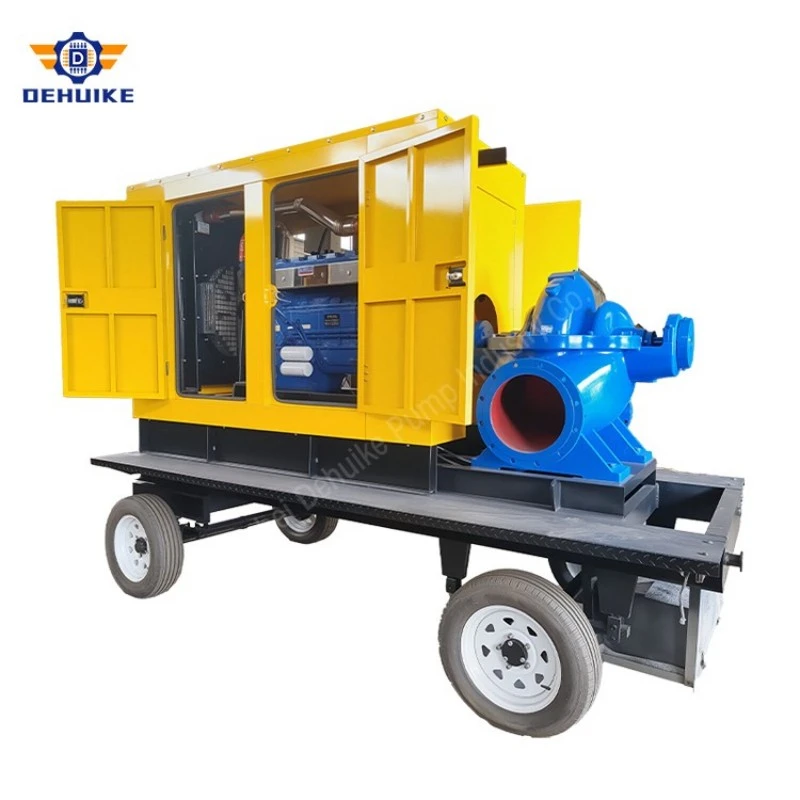
A worked example. Take 12Sh-9 / 300S58: 792 m³/h at 58 m, 1,450 rpm, 149 kW shaft, 180 kW motor, 84 percent efficiency, NPSHr 5.5 m, 572 kg. If the suction lift is 2 m, the suction line loses 0.8 m, and the site sits at sea level with water at 20 °C, available NPSH comes out near 7 m. That leaves about 1.5 m over the requirement, which is workable but not generous, and worth improving with a larger suction pipe if the layout allows.
At 1,450 rpm this model sits in the middle of the family. The small units run at 2,900 rpm and the large ones at 970, 740 or 600 rpm. Slower rotation costs casing size but buys bearing life, and on a 3,450 kW machine it is the only sensible choice.
Experience and Markets: Cross-Border Engineering Footprint and Municipal Infrastructure References
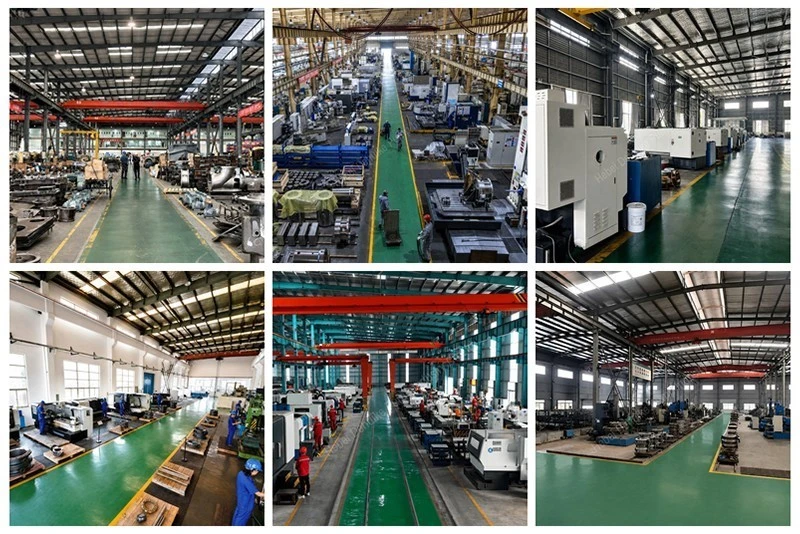
Engineering trust in heavy rotating machinery is earned through decades of documented field reliability, stringent manufacturing consistency, and successful operational references across demanding international operating environments. Over more than 30 years of dedicated pump manufacturing, our enterprise has established a solid international footprint, delivering specialized Double Entry Centrifugal Pump units to EPC contractors, municipal water utilities, and industrial plant operators across more than 50 countries globally.
A prime example of our international field performance is demonstrated in the municipal water infrastructure sector of the Philippines. For a provincial bulk water supply and booster station upgrade project, our engineering team manufactured and delivered four heavy-duty double-suction skid packages configured with custom SS304 impellers and duplex stainless steel shaft sleeves. Operating continuously under challenging monsoon humidity and fluctuating intake canal water levels, the units have provided uninterrupted bulk potable water distribution to over 350,000 municipal residents. Vibration monitoring records across four years of continuous operation have documented root-mean-square (RMS) baseline vibration levels consistently below 1.8 mm/s, demonstrating the dynamic balancing precision and structural stability of our factory rotor assemblies.
In the Middle East, our 2205 duplex stainless steel and nickel-aluminum bronze double-suction pumps serve in coastal industrial cooling water facilities and commercial seawater intake pumping stations. In Southeast Asian palm oil processing refineries and Indonesian open-pit mine dewatering circuits, our medium-head 10Sh and 12Sh series operate reliably under tropical ambient temperatures exceeding 45°C, delivering consistent volume delivery while resisting localized silt abrasion. Every international delivery is backed by fully documented material traceability, certified hydraulic test curves, and standardized commercial export packaging, ensuring seamless commissioning upon site arrival.
Company Advantages: Hebei Dehuike Manufacturing Infrastructure, 30+ Years Heritage, and Factory Direct Supply
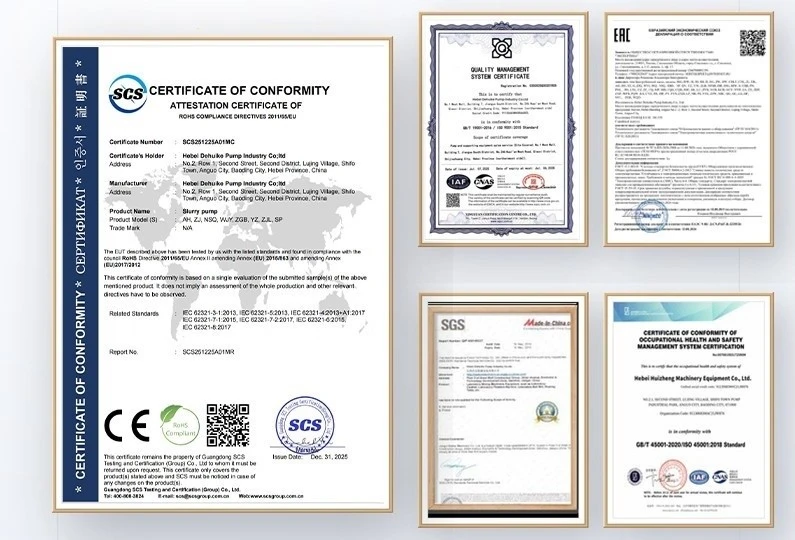
Hebei Dehuike Pump Industry Co., Ltd. stands as a specialized Chinese industrial pump manufacturing enterprise integrating hydraulic design, metallurgical casting, precision CNC machining, full-scale hydraulic testing, and global export support. Guided by our corporate philosophy-'Survive on Quality, Develop on Integrity'-we provide global industrial buyers with competitive, highly reliable pumping solutions backed by direct factory engineering resources.
- Over 30 Years of Specialized Manufacturing Heritage: With more than 30 years of focused experience in fluid machinery design and production, our technical engineering team combines proven classical volute hydraulics with contemporary computational fluid dynamics (CFD) modeling. This accumulated manufacturing expertise ensures that every Double Entry Centrifugal Pump achieves optimized hydraulic passage contours, reduced internal hydraulic eddy losses, and superior mechanical durability.
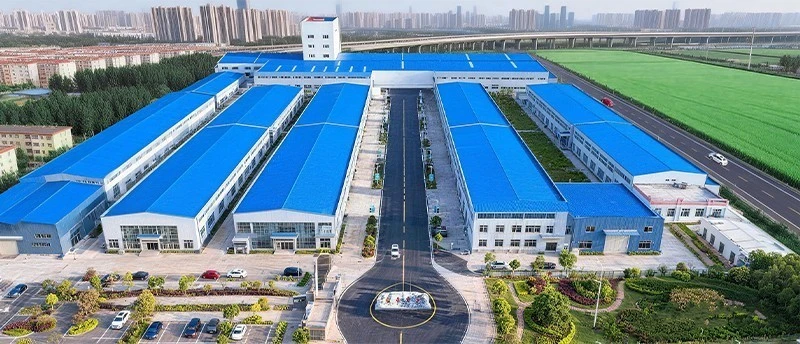
- Modern 6,000+ m² Production Facility & Integrated Foundry: Operating a modern workshop and assembly plant exceeding 6,000 square meters, our facility houses comprehensive manufacturing equipment including resin sand casting lines, vertical CNC turning lathes, horizontal boring machines, dynamic balancing rigs, and advanced heat treatment ovens. By managing the complete manufacturing chain-from raw metallurgical melts to final dynamic balancing and painting-we exercise total quality control over component hardness, wall thicknesses, and dimensional tolerances.
- Extensive Supply Chain Ecosystem with 900+ Qualified Partners: To ensure reliable material availability, rapid component turnaround, and scalable production capacity, Dehuike maintains long-term cooperative partnerships with more than 900 certified supply chain specialists. This vast ecosystem covers specialized alloy foundries, precision bearing manufacturers, mechanical seal technology providers, and electric motor suppliers, enabling us to deliver specialized custom-engineered pump skids within expedited project delivery schedules.
- Certified Quality Management & International Compliance: Dehuike operates in full compliance with the ISO 9001 international quality management system certification. Our product lines meet Eurasian Conformity (EAC) technical standards and European RoHS environmental directives, ensuring full compliance for major international public tenders and industrial EPC procurement protocols across Europe, Central Asia, and Southeast Asia.
- 24-Month Comprehensive Factory Warranty: We stand firmly behind our manufacturing craftsmanship by providing an industry-leading 2-year (24-month) comprehensive warranty on complete pump units (excluding standard consumable wearable parts such as gland packing, mechanical seal contact faces, and casing wear rings). This warranty commitment gives international buyers and EPC project managers solid contractual confidence and risk protection.
- Global Logistics and Secure Export Packing: To protect high-precision machinery during multimodal transport, each complete pumping unit is treated with internal anti-corrosion barrier coatings, fitted with protective flange blind covers, and secured within custom heavy-duty fumigated wooden crates reinforced with steel corner framing. We support professional international trade terms including FOB Chinese ports and CIF destination ports worldwide, coordinating reliable Ocean Freight for shipments exceeding 500 kg and expedited Air Freight for urgent component consignments between 50 kg and 500 kg. Direct inquiries and procurement consultations are managed through director@dhkpump.com or telephone +86 19503223662.
Frequently Asked Questions (FAQ): Engineering Inquiries, NPSHa Margins, and Procurement Specifications
Q1: What are the primary engineering differences between a single-suction end-suction pump and a Double Entry Centrifugal Pump?
A single-suction pump introduces liquid from one axial direction into an overhung impeller, generating substantial axial thrust forces that must be absorbed by heavy thrust bearings, and requiring complete piping disconnection to service the internal components. In contrast, a dual-entry machine introduces liquid symmetrically from both sides into a dual-inlet impeller supported between two outboard bearings. This configuration completely balances axial hydraulic forces, reduces required NPSH by halving the inlet eye velocity, and features an axially split casing that permits complete rotor and seal maintenance without disturbing suction or discharge piping.
Q2: How does a dual-suction casing prevent cavitation during low suction water conditions?
Cavitation occurs when localized static pressure drops below the fluid's vapor pressure, causing vapor bubble formation that violently implodes against the impeller vane surfaces. By splitting total intake flow Q into two identical streams of Q/2, the fluid velocity entering each eye of the double-suction impeller is substantially lower than in a single-suction design of identical capacity. Because NPSHr is strongly dependent on the square of fluid inlet velocity, the double-suction configuration achieves much lower NPSHr values (typically 4.0 to 5.5 meters across mid-range sizes), providing a safe operating margin above available site NPSH (NPSHa) even during severe reservoir drawdowns.
Q3: Which casing and impeller material combinations are recommended for brackish water or industrial cooling towers?
For standard municipal fresh water, high-strength grey cast iron (HT250) casing with cast iron or bronze impeller provides cost-effective service. For industrial cooling water treated with biocides and corrosion inhibitors, ductile iron (QT500-7) casing paired with SS304 or SS316 impellers and stainless steel wear rings is recommended. For brackish water, estuarine intake, or warm cooling circuits with chloride concentrations exceeding 1,000 ppm, full duplex 2205 stainless steel (CD4MCu) or nickel-aluminum bronze (C95800) construction provides superior resistance to chloride pitting, crevice corrosion, and erosion-corrosion.
Q4: Can the rotational direction and drive shaft orientation be modified in the field?
Yes. The horizontal split case design is fully symmetrical. The pump can be assembled for either clockwise (CW) or counter-clockwise (CCW) rotation viewing from the drive coupling end. If plant layout requirements change, the rotor assembly can be extracted, reversed 180 degrees, and re-installed within the lower casing, transferring the drive coupling shaft extension to the opposite side without requiring modifications to the pump foundation or casing castings.
Q5: How do renewable wear rings protect the overall operating efficiency of the pump?
As pressurized liquid discharges from the impeller periphery, a portion naturally recirculates back toward the low-pressure suction eye through the clearance gap between the impeller and the stationary casing. Renewable casing wear rings maintain a tight radial clearance (typically 0.25 to 0.45 mm depending on size). Over years of abrasive operation, wear occurs on these sacrificial rings rather than on the costly casing casting. Replacing the wear rings during routine overhauls fully restores factory clearance, eliminates internal recirculation leakage, and recovers optimal hydraulic efficiency.
Q6: What factory quality assurance and hydrostatic testing protocols are performed prior to dispatch?
Every pump manufactured at Dehuike undergoes rigorous pre-dispatch auditing. The raw casing castings are subjected to hydrostatic pressure testing at 1.5 times the maximum allowable working pressure (held for at least 30 minutes with zero leakage). Rotors are dynamically balanced to ISO 1940 Grade G2.5. Complete pump assemblies undergo closed-loop hydraulic performance testing per ISO 9906 Grade 2B/1B standards to verify flow, head, power, and efficiency curves prior to crating and export dispatch.

Hot Tags: double entry centrifugal pump, China double entry centrifugal pump manufacturers, suppliers, factory