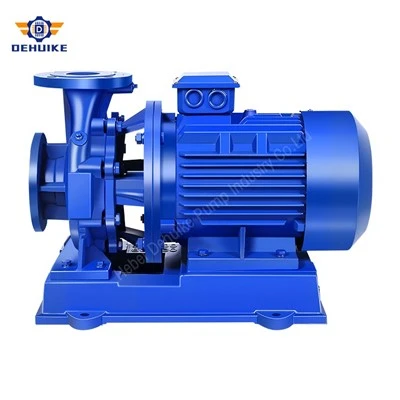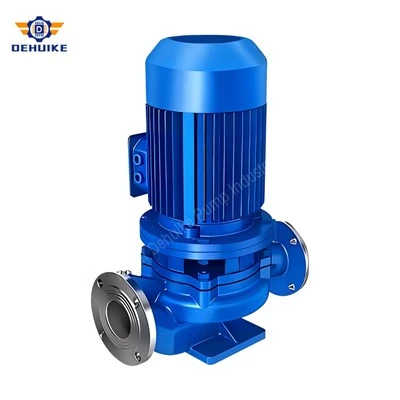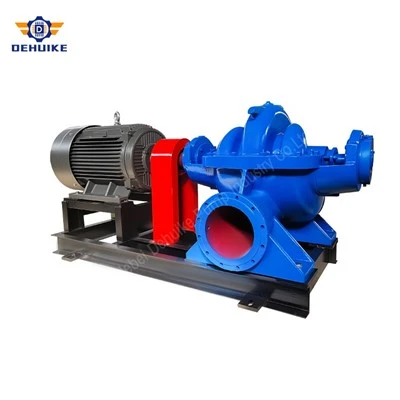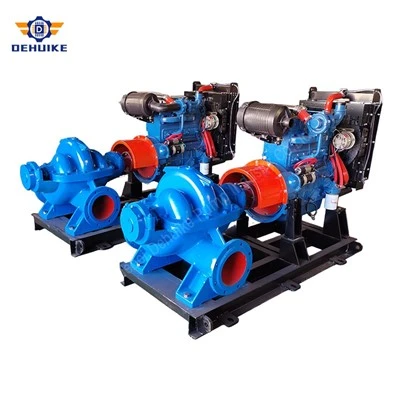

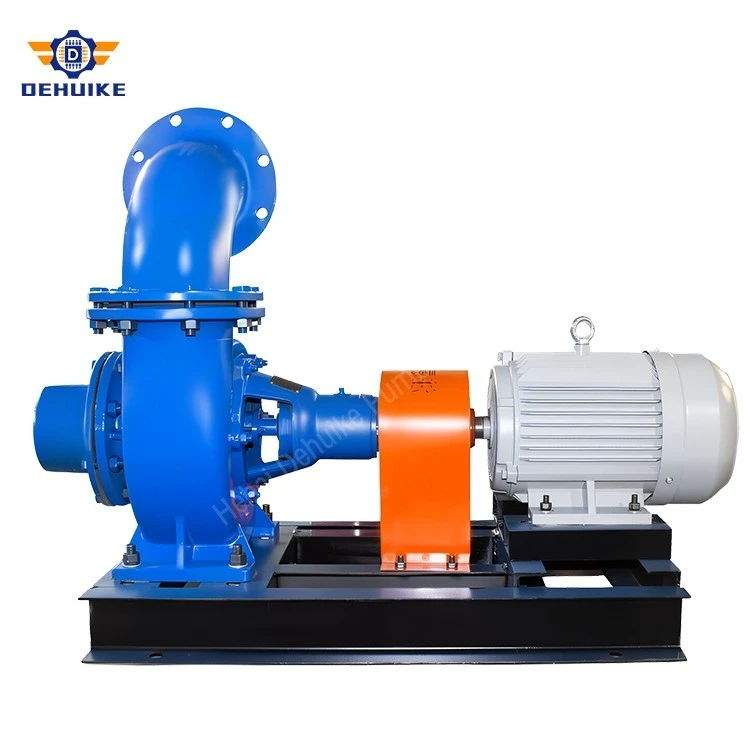
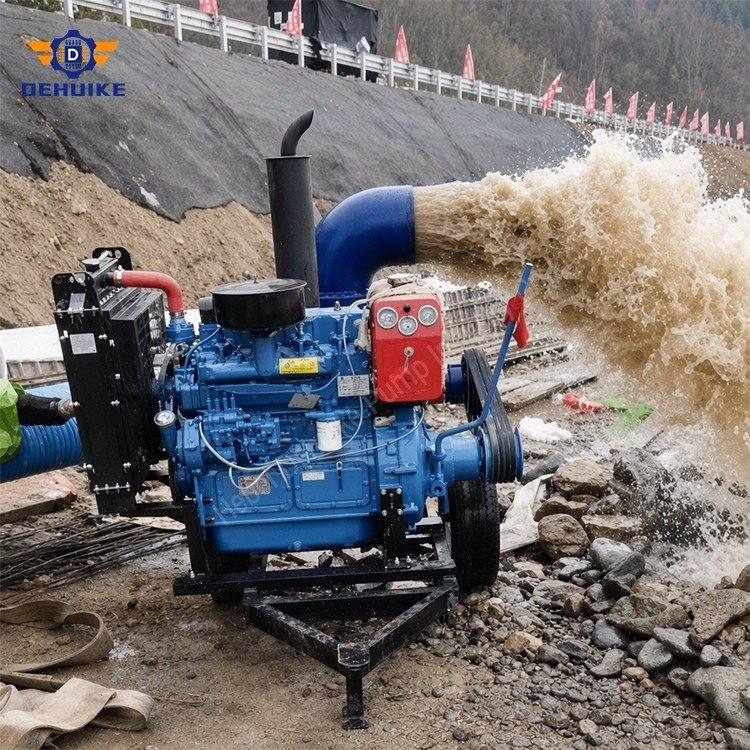
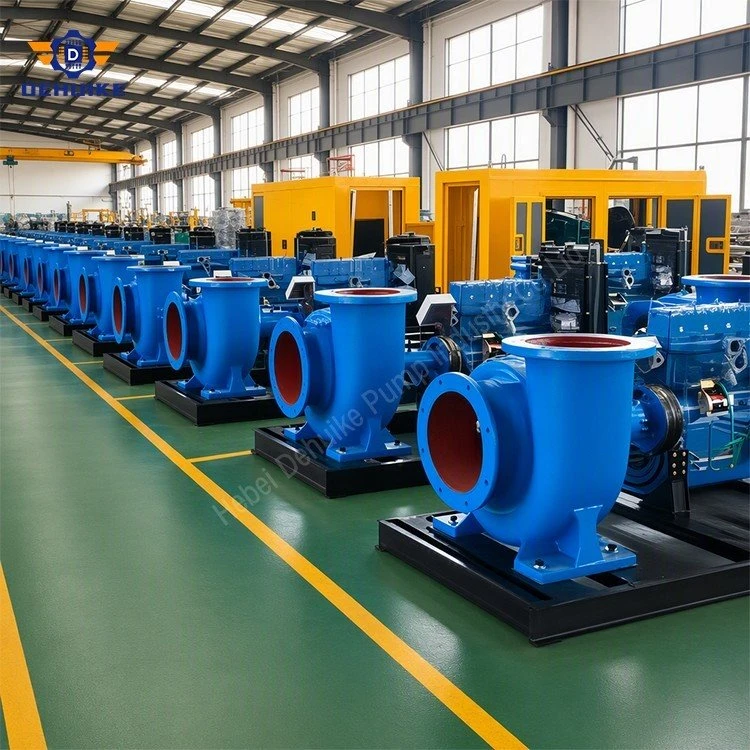
Hebei Dehuike Pump Industry Co., Ltd. is one of the most reliable manufacturers and suppliers of mixed flow irrigation pump in China. With abundant experience, we are committed to providing high quality customized pumps with competitive price. Welcome to wholesale bulk mixed flow irrigation pump for sale here from our factory. Also, pricelist is available.
Mixed Flow Pump: Moving a Lot of Water a Short Way Up
All four share the same rated head. What changes is the discharge aperture and, with it, the flow the unit can carry at that head. That is unusual in a pump family and worth understanding before a model number is chosen.
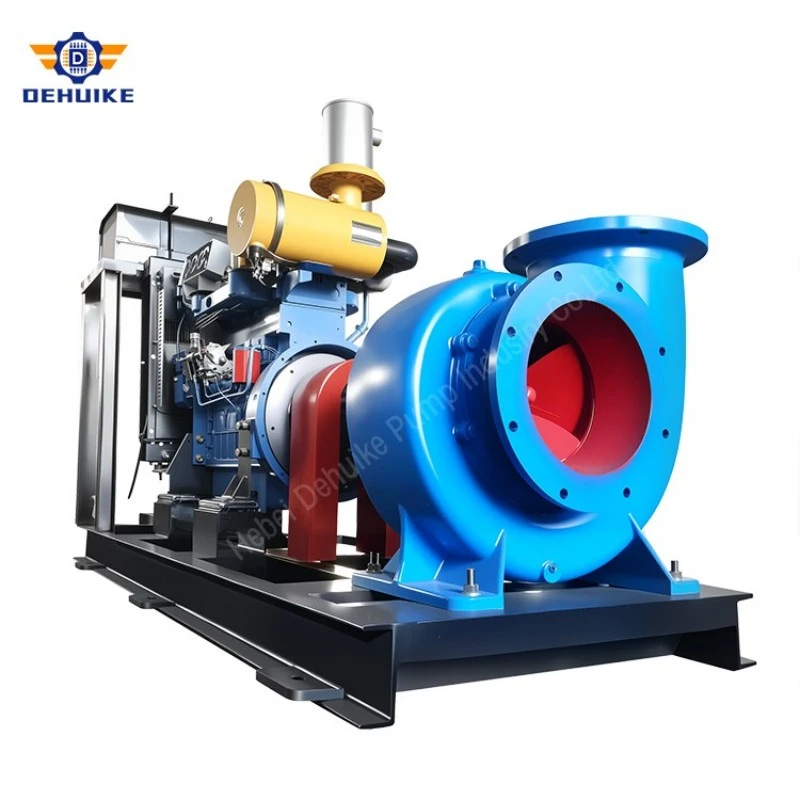
Table 1 DHW series horizontal mixed flow pump, rated at 1450 r/min
|
Model |
Discharge port (mm) |
Rated flow (m³/h) |
Rated head (m) |
Speed (r/min) |
Standard diesel |
Alternative drives |
|
DHW250-20 |
100 |
250 |
20 |
1450 |
8 HP |
Electric motor / tractor PTO |
|
DHW280-20 |
125 |
280 |
20 |
1450 |
8 HP |
Electric motor / tractor PTO |
|
DHW300-20 |
150 |
300 |
20 |
1450 |
15 HP |
Electric motor / tractor PTO |
|
DHW580-20 |
200 |
580 |
20 |
1450 |
22 HP |
Electric motor / tractor PTO |
The port is the column that decides how the installation behaves, because it sets the velocity at the flange. Two hundred and fifty cubic metres an hour through a 100 mm outlet is a quick stream, close to nine metres per second. That is fine for a short discharge into a ditch, and expensive for a kilometre of pipe, where every metre of extra velocity turns into friction that has to come out of the twenty-metre head. If the run is long, stepping up to the 125 or 150 mm model buys the same flow with a calmer discharge, and the pipe network thanks you for it.
There is a limit to this logic. All four models are twenty-metre machines. If a project needs thirty or forty metres, no amount of port juggling produces it, and the honest answer is a different family: a horizontal multistage or a higher-head radial pump. A mixed flow unit pushed past its band will run, but it will run away from its best point, and the efficiency loss shows up in fuel or electricity every hour of the season.
Diesel, motor or tractor: three ways to turn it
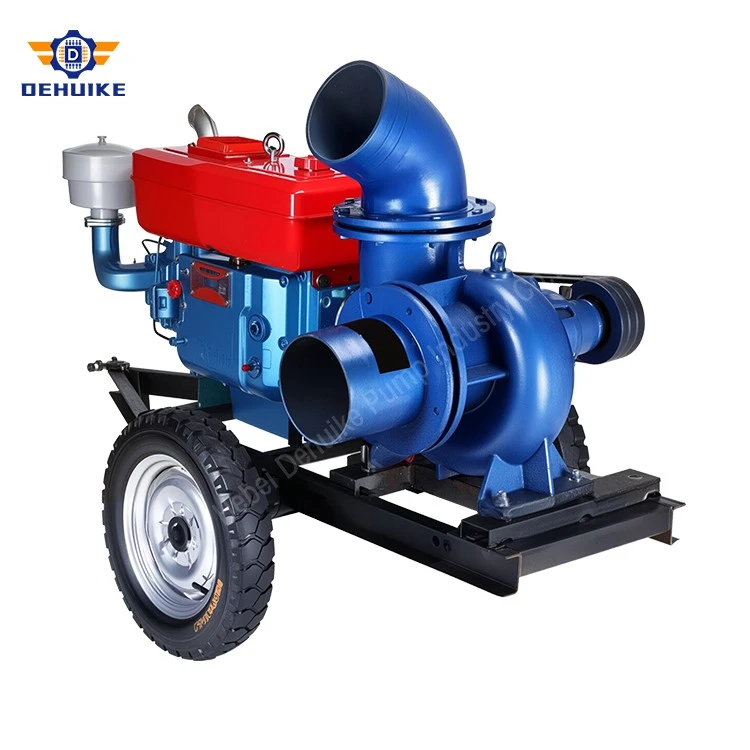
The same pump can be driven three ways, and the choice usually says more about the site than about the hydraulics.
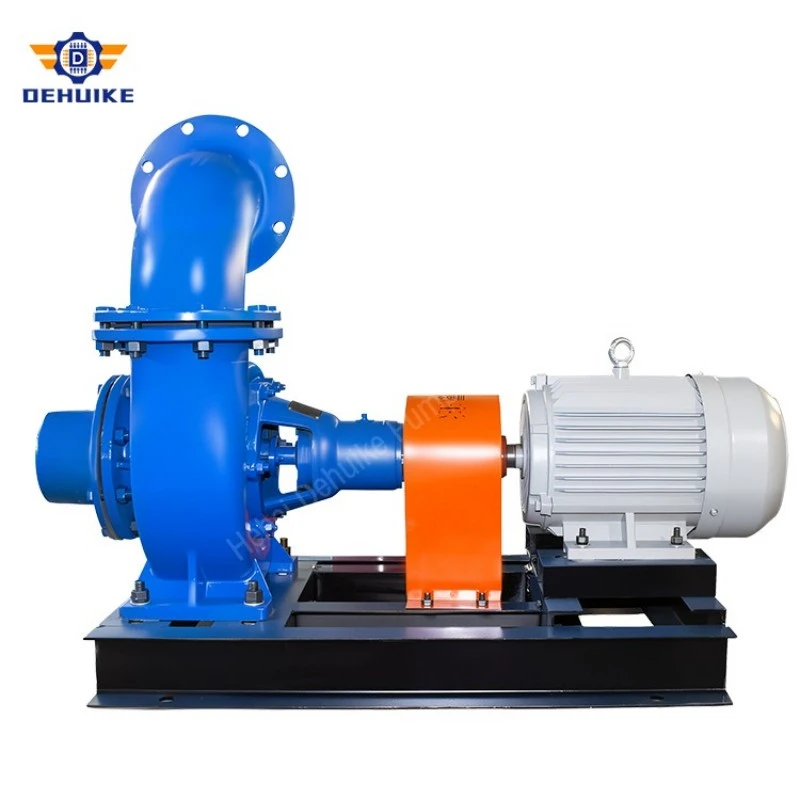
Table 2 Drive options and what they ask of the site
|
Drive |
Where it makes sense |
What to settle before ordering |
|
Diesel engine |
Fields, banks and flood zones without a dependable supply |
Fuel storage and delivery, enclosure and ventilation, governor response, starting battery, service access |
|
Electric motor |
Fixed stations on a stable grid, long running hours |
Voltage and frequency, starting method and supply capacity, protection and control, cable route |
|
Tractor PTO |
Farms that already own a tractor and move the pump between points |
PTO speed (540 or 1000 r/min), shaft and gearbox ratio, guard and hitch, tractor availability during the season |
What the site does to the pump
A mixed flow pump is usually installed by people who are not pump engineers, in conditions that were not in the design brief. Four of those conditions account for most of the trouble.
Suction lift. Five to six and a half metres is realistic at sea level with cold water, and less at altitude, with warm water, or through a long suction line with bends. The nameplate figure is not the site figure; work from the actual level, pipe bore and fittings.
Air. These pumps do not prime themselves. A foot valve, a priming pump or a vacuum arrangement is part of the installation, and a leaking suction flange gasket will defeat all three. If the unit loses prime overnight, look for the leak before looking at the pump.
Silt. Wide passages pass sand and debris, but abrasion still works on wear rings and impeller edges season after season. In heavily silted water, keep suction velocity high enough that solids do not settle in the pipe, and plan on renewing wear rings rather than replacing a casing.
Water level. A canal in the dry season is not the canal in the design drawing. Set the strainer depth and check the suction calculation at the lowest level expected, not the average, because that is the day the pump will cavitate.
Setting it up so the first season is quiet
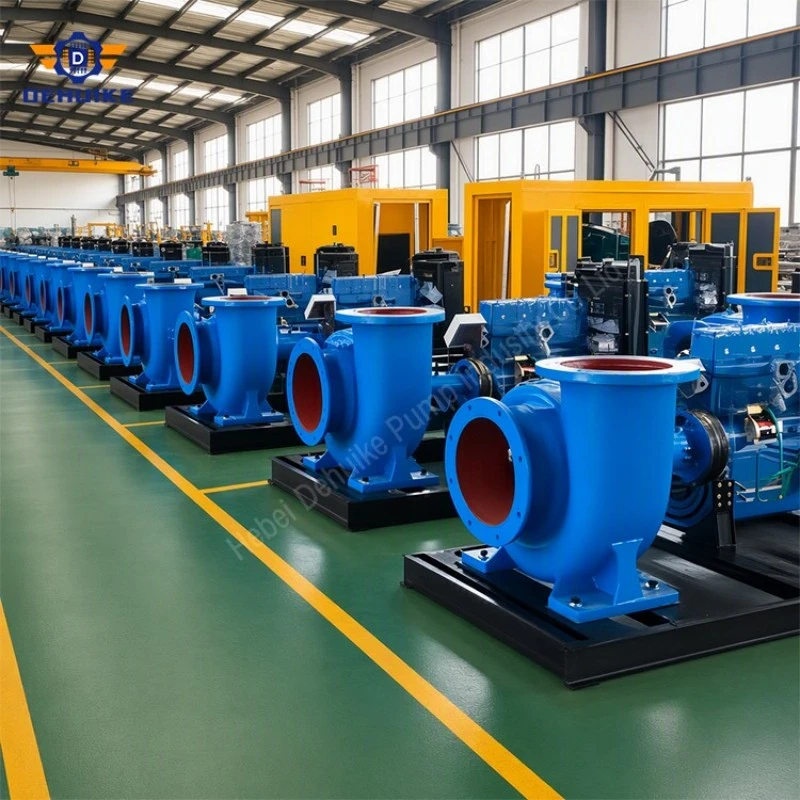
Mount the skid on firm, level ground, with the frame bearing on all its feet rather than on two. Align the coupling after the discharge pipe is connected, since a pipe that springs into place will move the pump the first time it heats up. Keep the suction line short, straight and one bore above the pump inlet where possible, and give the inlet enough submergence that the water does not draw a vortex and pull air down with it.
Prime before starting, open the discharge valve a little, then start and open gradually while watching the engine note or the ammeter. Steady running is the aim: a unit hunting up and down is usually fighting a suction restriction or a partly closed valve. Record suction and discharge pressure, flow and drive load on the first good run, because that sheet is the only baseline anyone will have when performance changes next season.
Between seasons

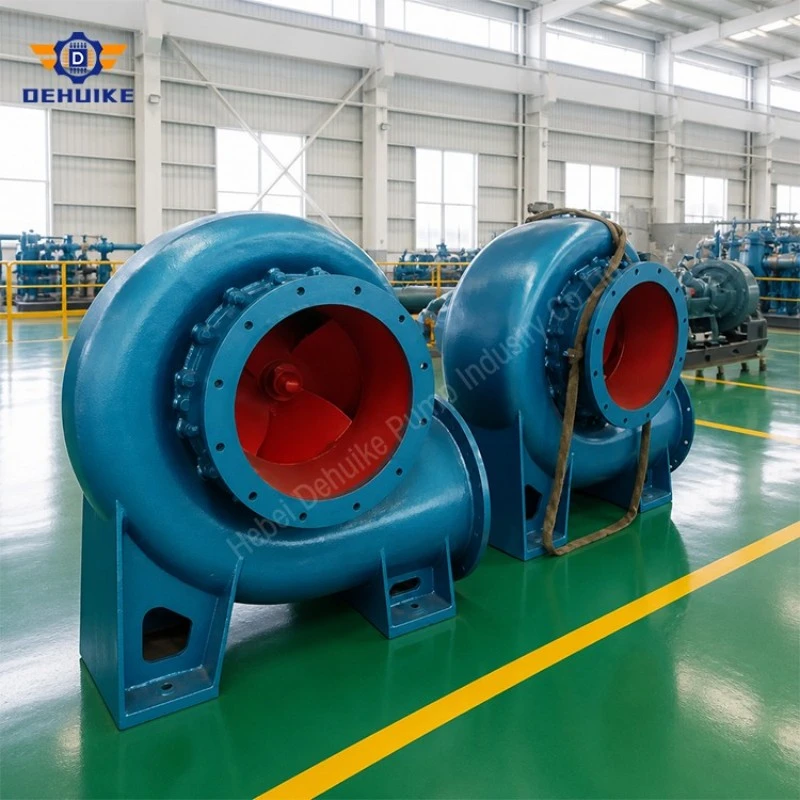
Most of the wear in a seasonal pump happens in the two weeks nobody is watching: the end of the season, when the unit is put away wet, and the start, when it is started dry.
At shutdown, open the drain at the bottom of the volute and let the casing empty, particularly where frost is possible, because ice in a casing cracks it. Grease the bearing bracket on the interval the manual gives, keep the gland packing at a slow steady drip rather than a dry box, and change the engine oil and filters on schedule if the unit is diesel driven. Store the suction hose off the ground and the foot valve clean.
At the start of the season, check the packing, spin the shaft by hand, confirm the coupling and guards, then prime properly. Wear rings and impeller edges are the parts to look at after a silty season; both are renewable, and renewing them early is cheaper than living with a pump that has lost its head.
Questions that come up before an order
When the head is beyond about twenty-five metres, or when the flow is small. Above that band a multistage or high-head radial pump is more efficient and easier to control. Below a few tens of cubic metres an hour, a mixed flow impeller is simply bigger and dearer than the duty needs. This family earns its place in the wide middle, not at either end.
Start from the flow the project must move at twenty metres, then look at the discharge run. Short runs into a ditch favour the smaller port; long mains, lifts into a reservoir, or discharge into a pressurised manifold favour the larger port for the same flow. Where the flow sits between two rows, the honest answer is a conversation about the curve rather than a guess at the nearest number.
Around five and a half to six and a half metres at sea level with cold water, and less as altitude, water temperature or suction line losses rise. Calculate the available NPSH for the worst case the site will actually see, and leave a margin of at least half a metre above the required figure. On a river bank that changes level weekly, the worst case is not the day of the survey.
Sand, silt and plant debris pass through the wide passages without choking the impeller, which is why these units are used on raw canal and river water. Heavy quartz sand or tailings is a different matter and calls for wear-resistant impeller material and hardened sleeves. Saying so at the enquiry is cheaper than discovering it after two seasons.
Dehuike Pump Industry builds the DHW range under ISO quality management system certification, with more than forty years in the industry, over thirty series of industrial pumps and customers in more than ninety countries. Send the flow, the head, the suction arrangement, the drive you prefer and the water condition, and the reply will be a model, a port size and the points that still need checking on site.
Hot Tags: mixed flow irrigation pump, China mixed flow irrigation pump manufacturers, suppliers, factory