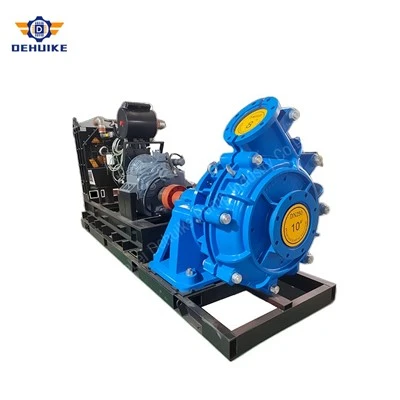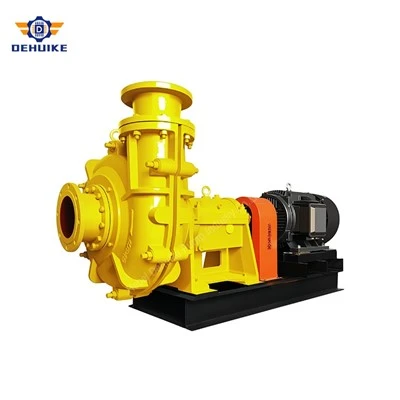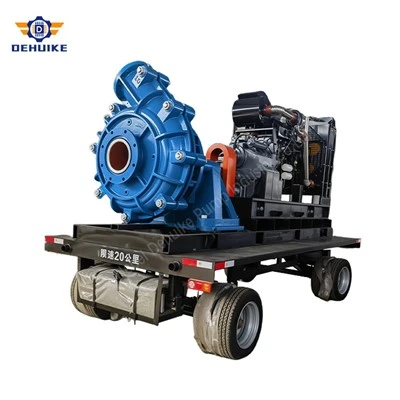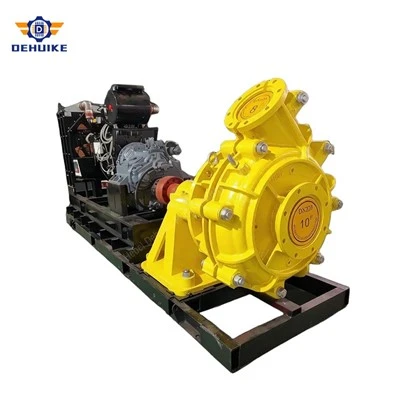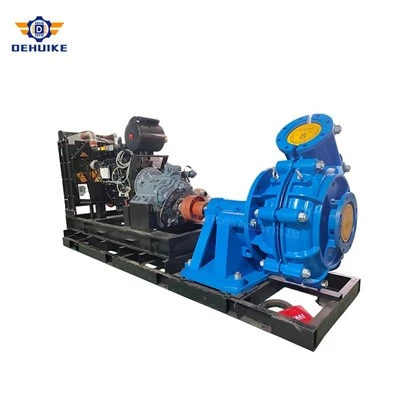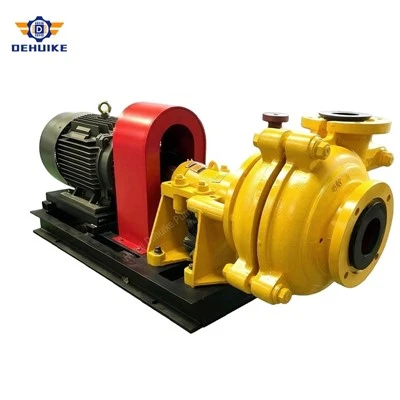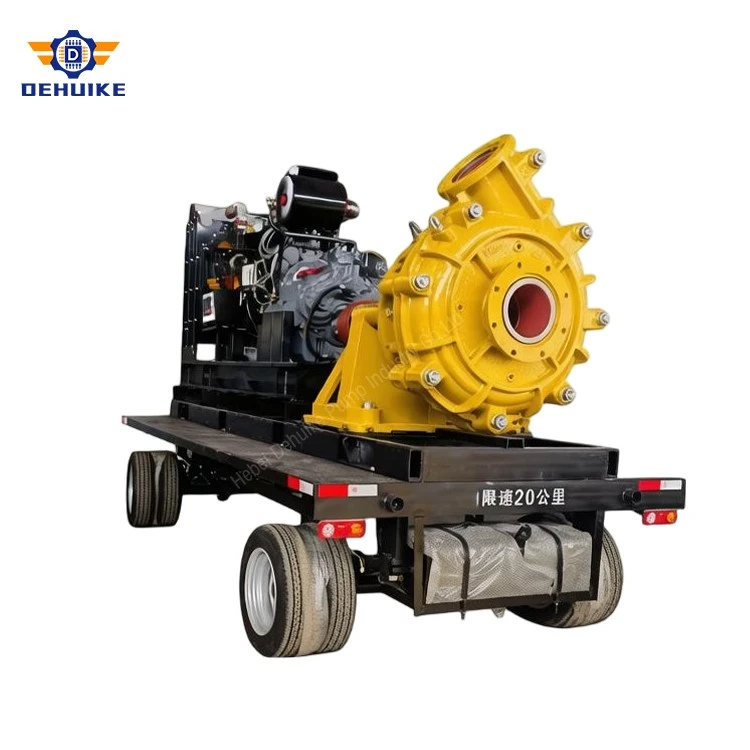
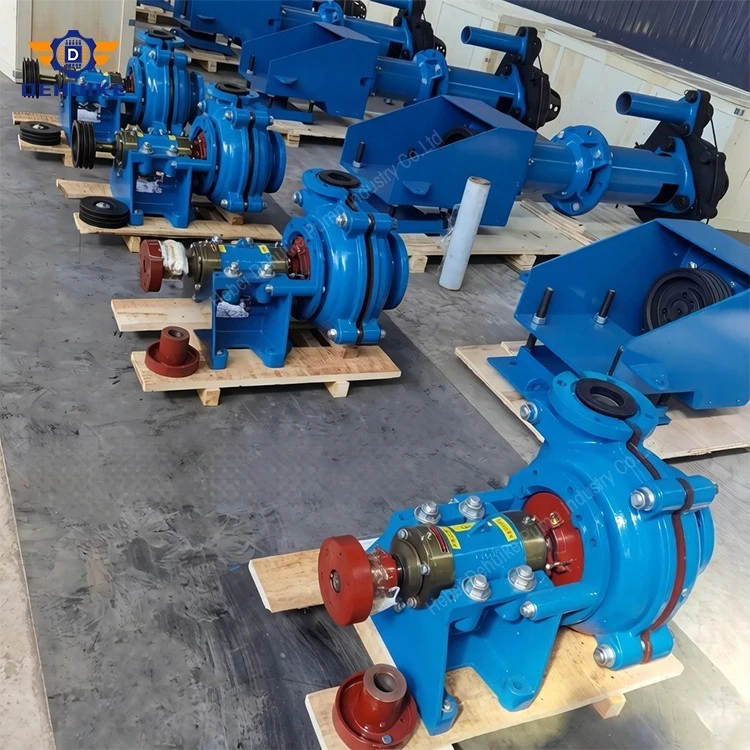
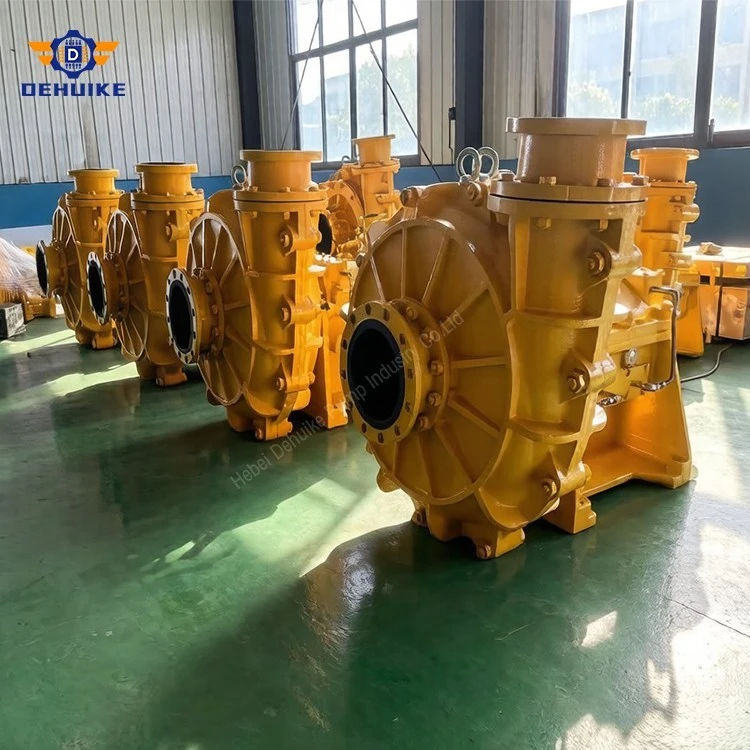
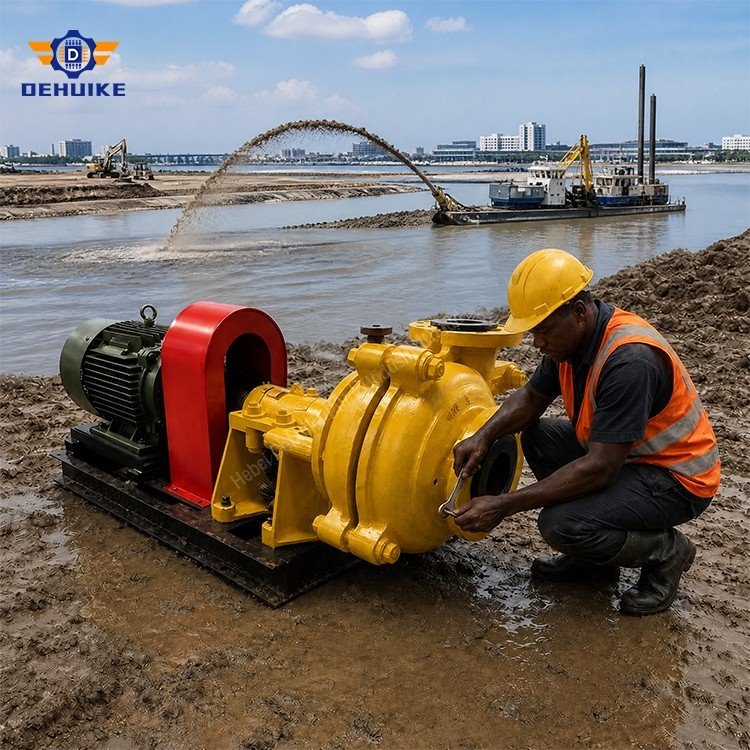
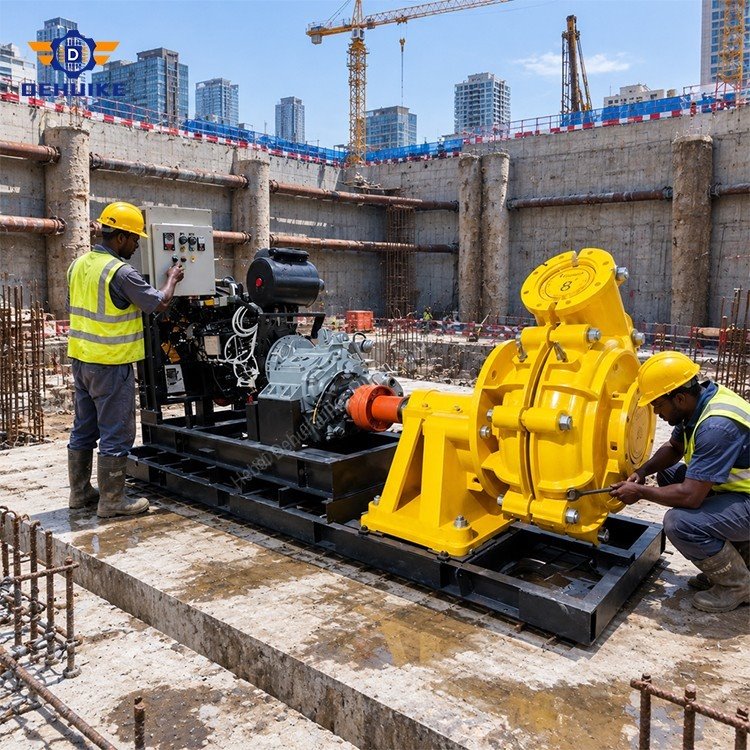
Hebei Dehuike Pump Industry Co., Ltd. is one of the most reliable manufacturers and suppliers of abrasion resistant slurry pump in China. With abundant experience, we are committed to providing high quality customized pumps with competitive price. Welcome to wholesale bulk abrasion resistant slurry pump for sale here from our factory. Also, pricelist is available.
Product Positioning
Abrasion Resistant Slurry Pump for High-Wear Process Media
A slurry pump quote usually begins with two numbers, flow and head, because that is how clear-water pumps are sold. Both numbers are correct and neither is sufficient. The moment the liquid carries solids, the duty stops being a hydraulic question and becomes a materials-and-velocity question, and the pump that looks right on a water curve is often the one that fails in the first quarter.
Four properties of the slurry do most of the damage, in this order: how heavy it is, how fast it settles, how big and how hard the particles are. Each one translates into a decision about motor size, pipe size, wet-end material and shaft speed, and each one is cheap to establish before the order and expensive to discover after it.
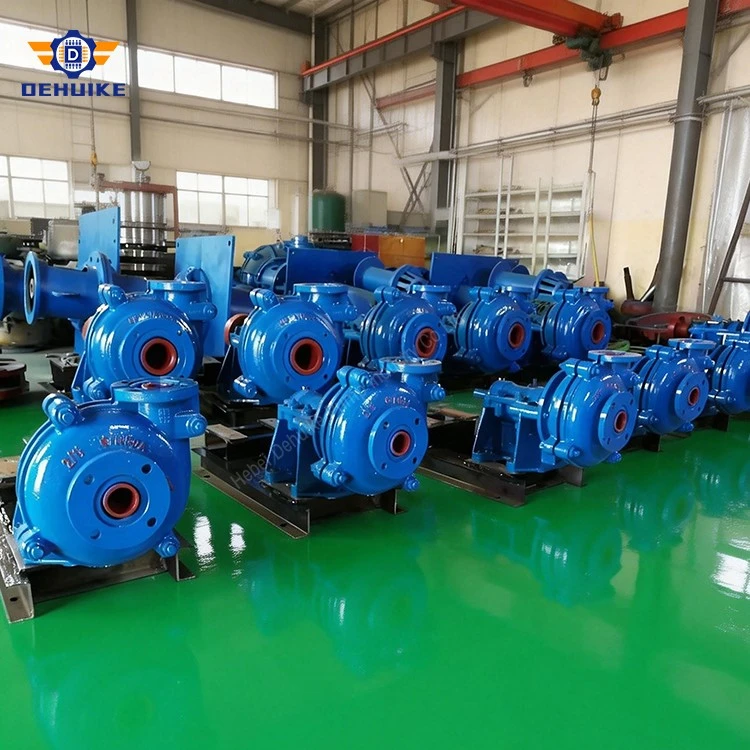
Density: the motor you did not size
Pump power is flow times head times density. Water has a specific gravity of 1.0 and a dense tailings stream can sit at 1.3 to 1.5 or higher, which means the same volumetric flow at the same head needs 30 to 50 per cent more shaft power. A pump selected on a water power figure and fitted with a motor to match will run overloaded every hour of its life, and the thermal relay will spend its time explaining this to the operator.
The same arithmetic applies to head. A head of 40 m measured in metres of slurry is a heavier column than 40 m of water, and a froth or a flotation feed with entrained air is lighter than the calculation assumes. Both directions of error exist, which is why a slurry duty should be quoted by density and not by the reassuring word "water".
Table 1 Shaft power for the same duty at different slurry densities
|
Slurry specific gravity |
1.0 (water) |
1.2 |
1.3 |
1.5 |
|
Shaft power at 500 m³/h, 40 m head, 70% efficiency |
78 kW |
94 kW |
101 kW |
117 kW |
|
Sensible motor selection |
90 kW |
110 kW |
132 kW |
132 kW |
One further trap sits in the same line. Density in a sump is not constant. A settled tank delivers a thin stream at the top and a heavy one at the bottom, and a pump taking suction near the floor can meet a slug of solids far denser than the design figure. Motors on slurry duty are usually chosen with margin for exactly this reason, and the margin is not laziness.
Settling: the pipe is part of the pump
Fine solids stay in suspension at almost any velocity. Coarse sand and mill discharge do not. Below a certain velocity the particles begin to deposit on the invert of the pipe, the bed grows, the free area shrinks, the velocity over the bed rises, and the line oscillates between partial blockage and sudden clearing. That velocity threshold is the critical velocity, and it is a property of the solids and the pipe diameter, not of the pump.
This has a counter-intuitive consequence for sizing: a larger pipe is not automatically better. Increasing the bore lowers the velocity for the same flow, and if it falls below the critical value the line starts to sand up. Slurry lines are therefore sized on velocity first and friction loss second, and the pump is selected afterwards to deliver that flow at whatever head the chosen pipe costs.
Throttling is the other mistake carried over from clean-water practice. On water, a partly closed valve is an inefficient but workable way to trim flow. On slurry, it slows the mixture in the line behind it, and the solids settle in exactly the place where nobody can see them. Where flow has to be varied, a variable-speed drive or a smaller impeller is the correct answer; a valve on a slurry discharge is a maintenance item waiting to happen.
Particle size, and what the model code already tells you
Slurry pump codes are written from the pipe connections inward. In a designation such as 8/6E-DAH the first figure is the discharge branch in inches, the second the suction branch, and the letter marks the frame size and therefore the power the bearing assembly is built to carry. In the published range the frames run from E at 120 kW through R at 300 kW and ST at 560 kW to TU at 1,200 kW, which is why the same hydraulic end appears under several codes.
The trailing letters describe the duty. DAH indicates a heavy-duty design; M means metal wetted parts, normally a high-chrome alloy; RU means rubber-lined. The largest passage in the machine is set by the suction branch and the impeller eye, so a 6-inch suction side will not pass a rock that a 10-inch machine swallows. Particle size is therefore a selection constraint before it is a wear question, and the largest single particle matters more than the average of the distribution.
Table 2 Selected models from the published range, with frame, material and duty window
|
Model |
Frame / material |
Flow (m³/h) |
Head (m) |
Speed (r/min) |
Max power (kW) |
|
8/6E-DAH |
E / metal |
324 to 828 |
7 to 70 |
400 to 1,140 |
120 |
|
8/6R-DAH |
R / metal |
324 to 828 |
7 to 70 |
400 to 1,140 |
300 |
|
8/6T-HH |
T / metal |
576 to 1,152 |
32 to 95 |
450 to 725 |
1,200 |
|
10/8R-M |
R / metal |
540 to 1,228 |
15 to 61 |
600 to 1,100 |
300 |
|
12/10ST-DAH |
ST / metal |
720 to 1,980 |
7 to 68 |
300 to 800 |
560 |
|
16/14TU-DAH |
TU / metal |
1,368 to 3,060 |
11 to 63 |
250 to 550 |
1,200 |
|
18/16TU-DAH |
TU / metal |
2,160 to 5,040 |
8 to 66 |
200 to 500 |
1,200 |
Wear, and the one variable that controls it
Three mechanisms do the damage. Sliding or cutting wear from particles dragged along a surface, which is worst at shallow impact angles and dominates in the casing and the impeller passage. Impact wear from particles striking a surface nearly square on, which pits the leading edge of the impeller vane and the throat. And erosion-corrosion, where a chemically active liquid removes the protective oxide from the metal and the particles then remove the bare metal underneath, which is why a mildly acidic slurry can destroy a high-chrome part far faster than a neutral one of the same abrasiveness.
The material answers follow the mechanism rather than the marketing. Hard high-chrome alloys resist cutting and impact from sharp mineral particles and are the default for mill discharge, coarse tailings and anything with hard rock in it. Elastomer linings absorb impact and suit finer, more rounded particles where the chemistry permits, and they lose their advantage quickly when a few coarse lumps appear in the stream. A particle size distribution with 95 per cent fines and 5 per cent gravel is a rubber-killer, because the damage is done by the tail of the curve, not the average.
The variable that outweighs both materials is velocity. Wear rate climbs steeply with speed, roughly as a power of the relative velocity between particle and surface, so a pump running 20 per cent slower can wear several times longer for the same duty. That is why the practical rule in heavy-duty slurry service is to buy the largest, slowest machine the duty allows rather than the smallest that meets the head: the bigger pump costs more at order and much less over five years of wear parts.
It also explains why running a slurry pump far from its design point is expensive in a way that has nothing to do with efficiency. Recirculation at low flow throws particles back onto the impeller inlet at a bad angle, and the wear there can be worse than at full flow.
The seal water you pay for every hour
Shaft sealing is where a slurry pump quietly consumes a second budget. A gland-packed pump needs a continuous flow of clean water through the lantern ring to keep solids out of the packing; a mechanical seal needs clean flush liquid for the same reason; an expeller or centrifugal seal uses the pump's own rotation to hold the slurry away from the gland and can run with little or no water, at the cost of some power and a strict no-dry-running discipline.
The water figure is easy to forget because it is small per hour. At 2 m³/h per pump, a single unit running continuously takes about 17,500 m³ a year, which is a real cost at any industrial water tariff and a serious one where water has to be bought, treated or pumped. It also lands in the process: flush water dilutes the slurry, changes the density the pipeline was designed around, and adds volume to a tailings pond that may already be at its limit.
Selecting between the three arrangements is therefore a plant decision rather than a pump decision. Gland packing tolerates some solids, is cheap to replace and needs water. Mechanical seals need cleaner water and more care but leak less. Expeller seals suit duties where water is scarce or dilution is unacceptable, provided the pump is never run dry and the expeller is correctly sized for the suction pressure at the gland. Whichever is chosen, the flush or barrier pressure has to be set above the pump discharge pressure at the gland, or the seal will be passing slurry instead of water.
Stopping is part of the duty
A slurry line that stops is a slurry line that starts settling. Solids fall out of suspension within minutes in a coarse duty, and the bed that forms may be harder to move than the original mixture. Stations that handle this well share the same habits: flush the pump and the discharge line with clean water before shutdown, keep the suction line short and free of low points where a bed can form, and never leave a pump sitting full of settled solids for a weekend.
Restart deserves the same attention. A pump started into a line that already contains a bed will run at a fraction of its design flow with the motor at full load, which is exactly the condition that overheats a winding and breaks a shaft. Starting against a closed discharge valve is normal practice, but it has to be opened promptly, and the current should be watched during the first minute rather than logged afterwards.

FAQ
Q: Can a slurry pump run on water for commissioning?
A: Yes, and it usually should, but the power will be lower than the slurry duty and the flow will be higher for the same head. Read the water curve for the flush and test runs, the slurry figures for production, and do not mix the two when checking the motor.
Q: Is high chrome always better than rubber?
A: For sharp, coarse mineral particles it generally is. For fine, rounded particles in a chemically compatible liquid, an elastomer lining can outlast metal and cost less to replace. The selection depends on the particle size distribution and the chemistry, and the supplier needs both to answer properly.
Q: How often should wear parts be replaced?
A: By measurement rather than by calendar. Record the throat clearance and the impeller diameter at each inspection, and replace when the clearance has grown enough to cost capacity or the part is close to losing its profile. A fixed interval guessed at the start of the contract is usually either wasteful or unsafe.
Q: What data does a quotation actually need?
A: Flow, total head in metres of slurry, specific gravity, solids concentration by weight or volume, the full particle size range with the largest lump, temperature, pH and chemical composition, the pipeline diameter and length, suction conditions and the power supply. With those, the wet-end material, speed and seal can be chosen together instead of one at a time.
Dehuike Pump Industry builds heavy-duty slurry pumps from 8/6 to 20/18 in metal and rubber-lined configurations, with frame sizes rated to 1,200 kW and flows to 5,400 m³/h. Manufacturing runs under ISO quality management system certification, on more than forty years of pump experience, across over thirty product series and customers in more than ninety countries. Send the slurry analysis rather than the pump name, and the selection will be argued from the solids.

Hot Tags: abrasion resistant slurry pump, China abrasion resistant slurry pump manufacturers, suppliers, factory