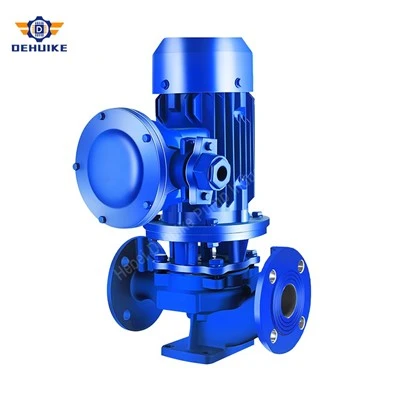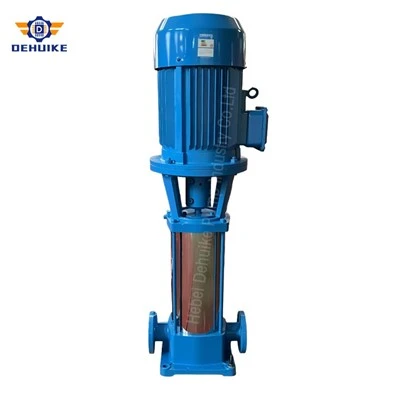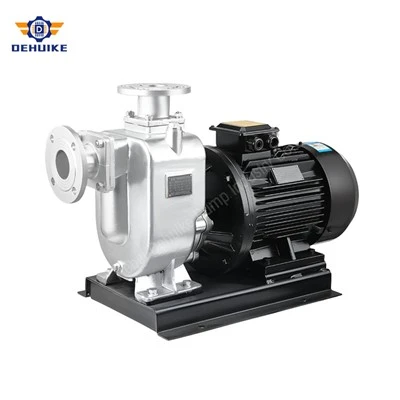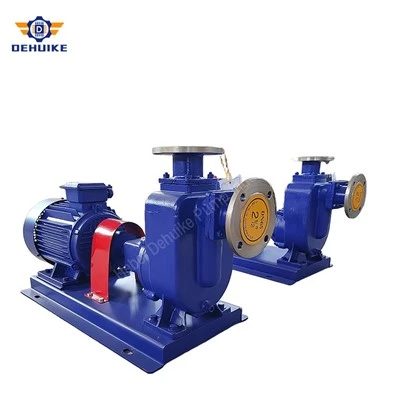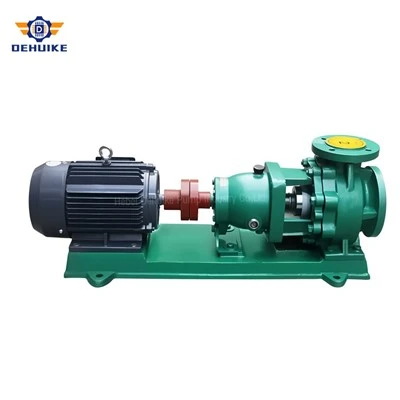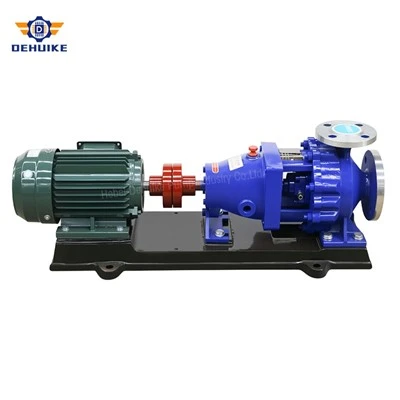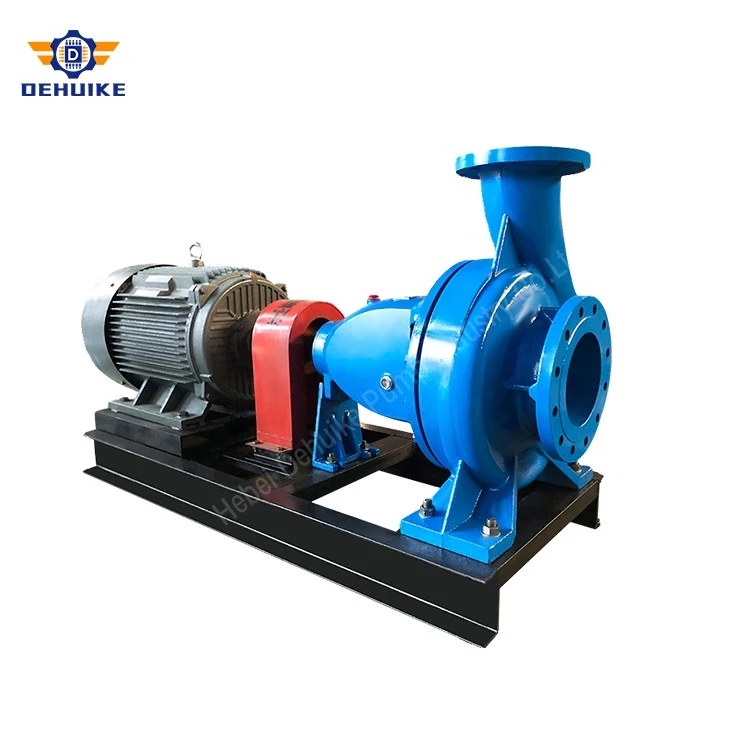
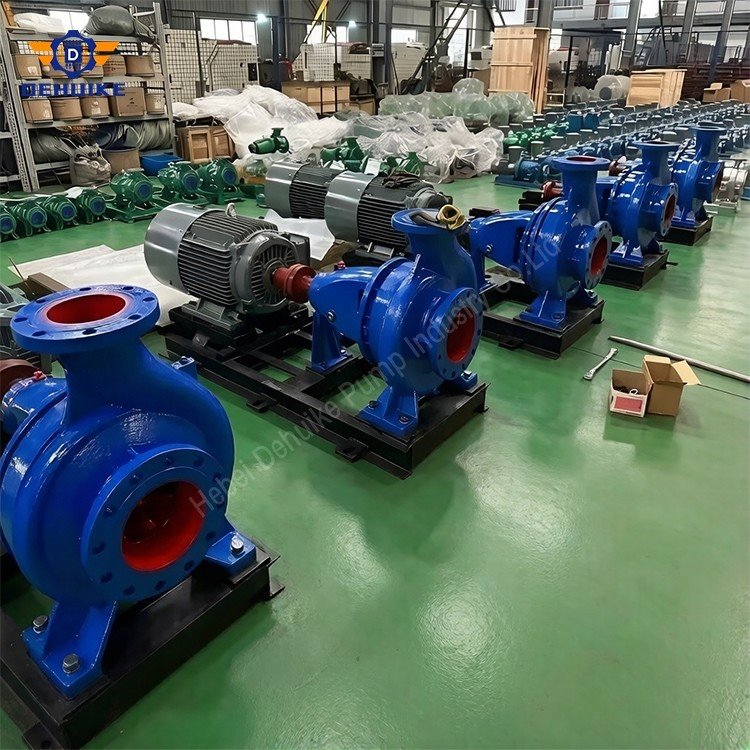
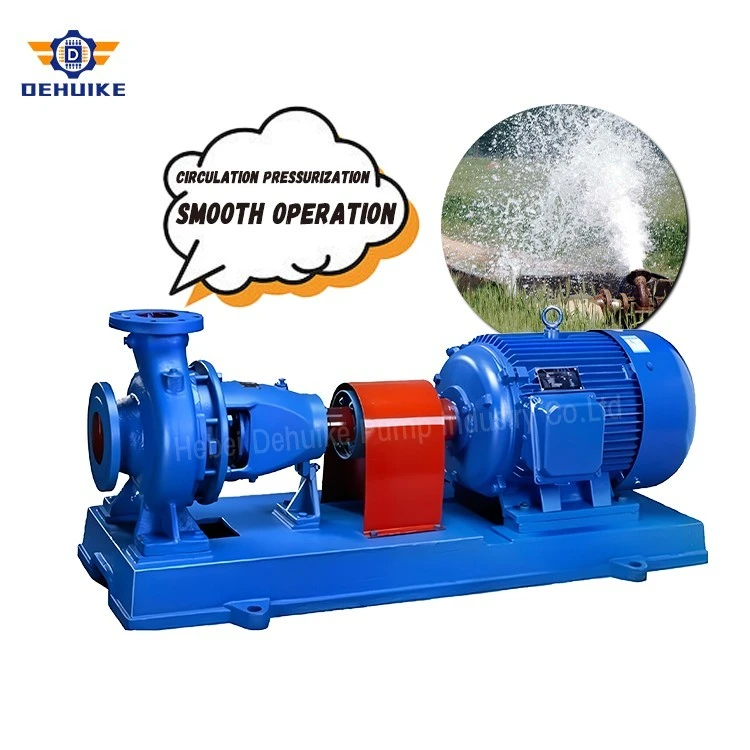
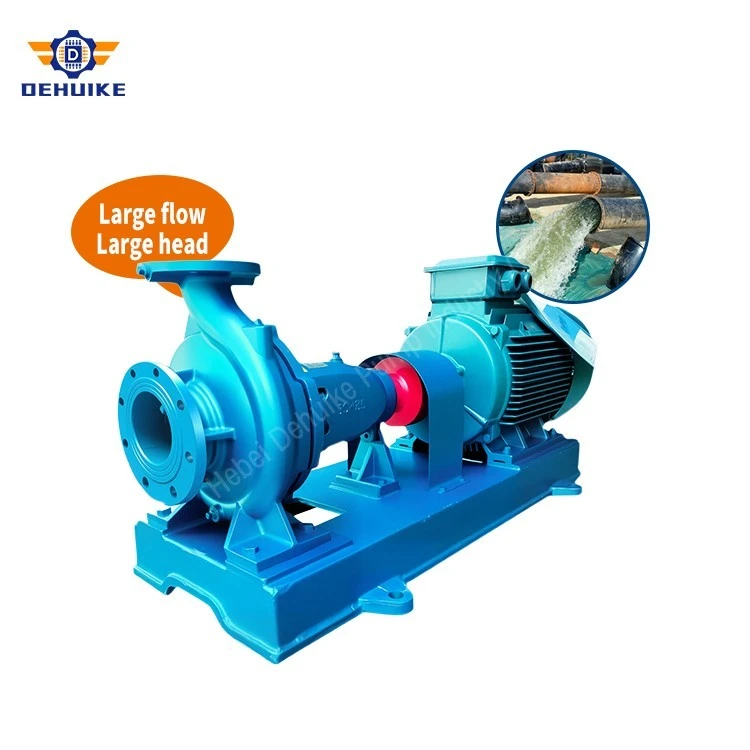
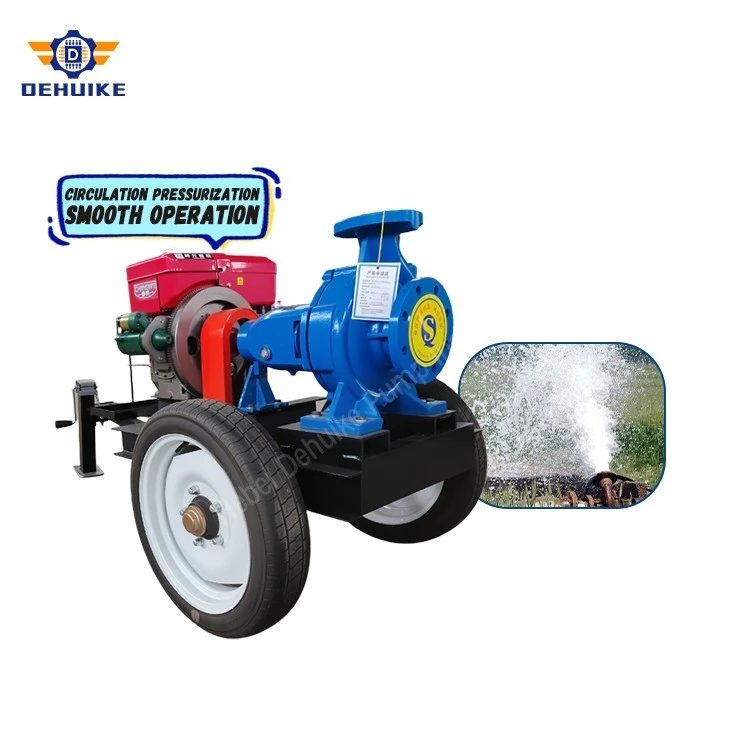
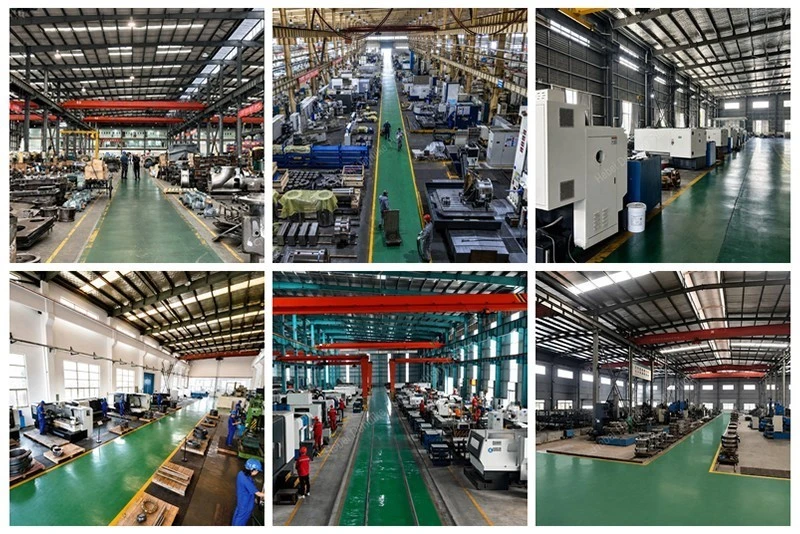
Hebei Dehuike Pump Industry Co., Ltd. is one of the most reliable manufacturers and suppliers of is irrigation centrifugal pump in China. With abundant experience, we are committed to providing high quality customized pumps with competitive price. Welcome to wholesale bulk is irrigation centrifugal pump for sale here from our factory. Also, pricelist is available.
Introduction
Read a model list for the IS end suction range and the codes look complete: 80-50-200, 100-65-315, 125-100-400. Suction bore, discharge bore, impeller diameter in millimetres. Nothing about speed, and speed is what actually sets the duty.
The clearest evidence sits in the manufacturer's own tables. Take IS 80-50-200: at 2900 r/min it delivers 30 m³/h at a 53 m head on a 15 kW motor, and at 1450 r/min the identical code delivers 15 m³/h at 13.2 m on a 2.2 kW motor. Same suction, same discharge, same nominal impeller size, and the head differs by a factor of four. A buyer who compares quotations by model code alone is comparing two different machines with the same name.
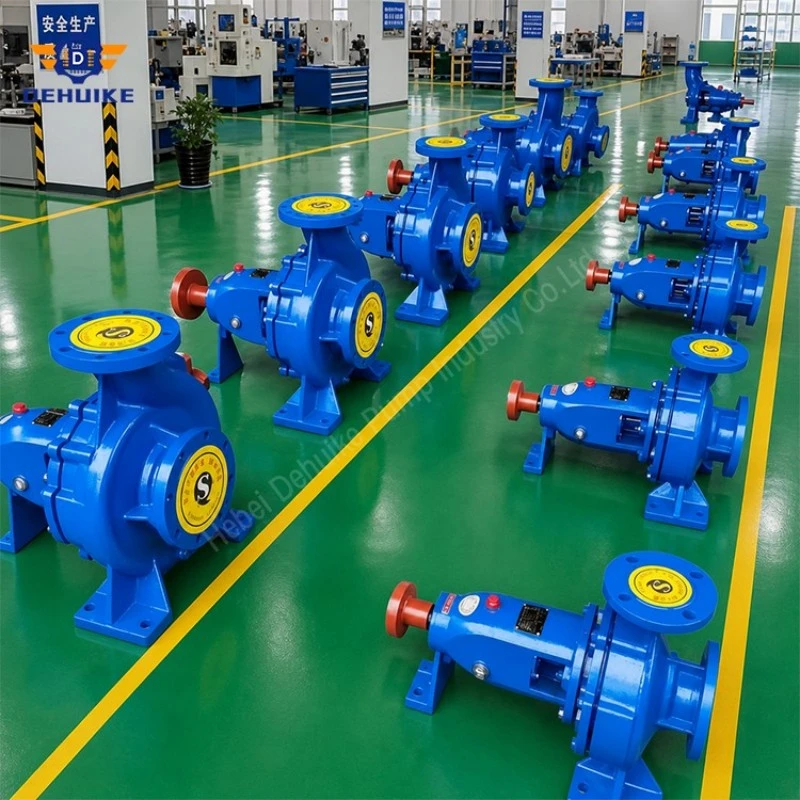
Why halving the speed quarters the head
The relationships are old and exact enough to design around. Flow scales with speed, head with the square of speed, and shaft power with the cube. Halve the speed and the flow halves, the head falls to a quarter, and the power falls to about an eighth. Efficiency at the corresponding point barely moves, which is why the slow machine is not simply a weak machine - it is a differently shaped one, doing the same hydraulic job at a gentler pace.
The vendor figures follow the rule closely. Between 2900 and 1450 r/min, the flow ratio on the three models quoted above is exactly 2.0, and the head ratios are 4.01, 3.94 and 4.00. Power does not quite reach eight, partly because the smaller motor frames carry more margin and partly because the efficiency point shifts as the machine runs at a lower Reynolds number. That shortfall is worth remembering when a proposal claims a perfect affinity prediction; real machines are close to the law, not identical to it.
The fourth relationship is the one that decides installations. Required NPSH scales roughly with the square of speed as well, so a pump that needs 2.5 m at 2900 r/min needs about 0.6 m at 1450 r/min. On a suction-limited site - a tank with little height above the pump, a long suction run, warm water - the slow version can be the difference between a pump that runs for ten years and one that is rebuilt every second season. It is also quieter and gentler on the seal, since surface speed at the seal faces and bearing loads both fall.
What the slow version costs, and where it stops being the answer
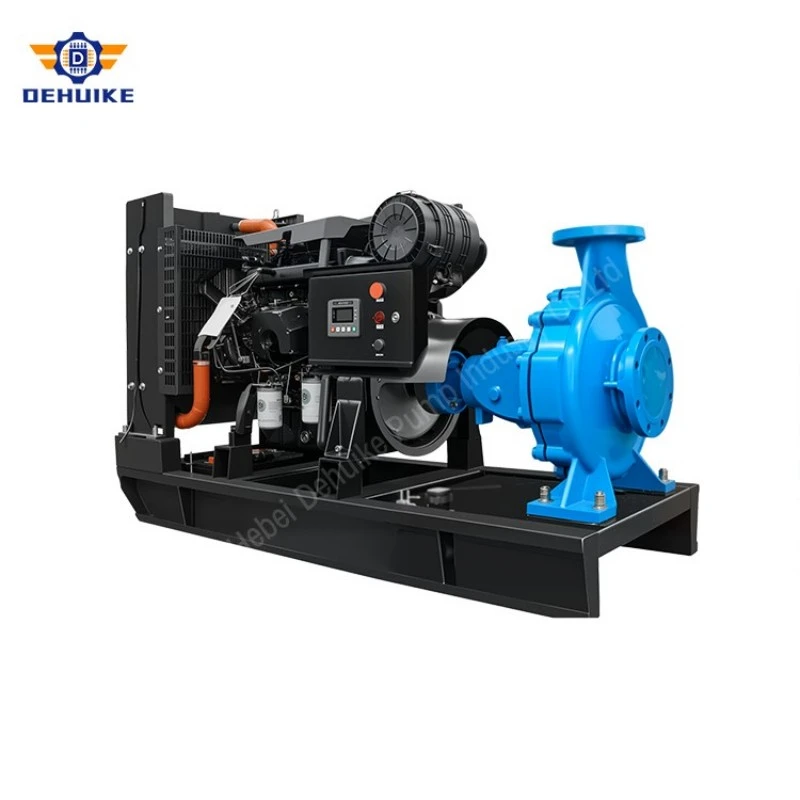
Nothing is free. For the same duty, a 1450 r/min pump needs a larger casing and a larger impeller, so the machine occupies more floor and weighs more. It also develops less head per stage, which is why high-head duties in this range live at 2900 r/min: IS 80-50-315 reaches 128 m at 2900 r/min and only 32.5 m at 1450. If the system needs 120 m and the flow is 30 m³/h, there is no slow option in that frame - the choice is a two-pole machine or a multistage pump of a different family.
The practical rule, then, is not "always choose 1450" but "choose the lowest speed that still meets the duty with an acceptable impeller size". Transfer duties, cooling water, irrigation distribution and building water supply usually satisfy that at four poles. Booster duties with high discharge pressure, and anything needing more than roughly 60 m from a single stage, tend toward two poles.
There is a third consideration that often settles it: the motor. A two-pole machine runs the bearings at twice the speed and generates noticeably more noise and vibration, and the coupling and base have to suit it. A four-pole machine on the same duty is quieter, but its motor is larger for the same power because torque is higher - which matters when the pump sits in a plant room with limited space.
The trim letter is the fine adjustment, not a second design
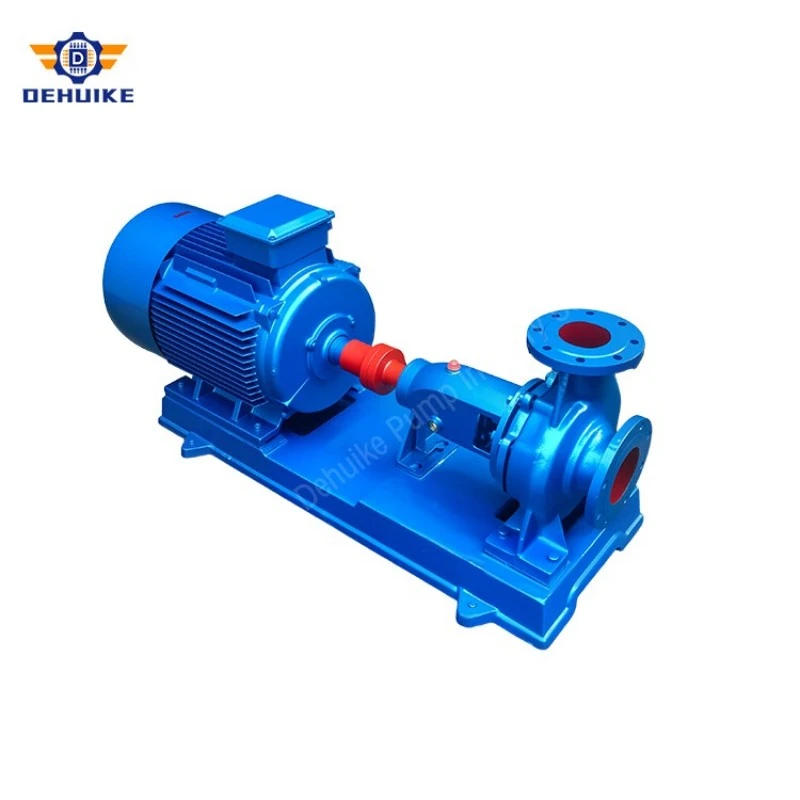
The suffix A on an IS model marks a trimmed impeller. It is the standard way to land between two catalogue points without changing the casing: IS 80-65-125 delivers 50 m³/h at 20 m, and the A version delivers 44.7 m³/h at 16 m, with the motor dropping from 5.5 to 4 kW. The same pattern repeats across the range, with flow reductions of roughly ten per cent and head reductions a little larger.
What the trim does not do is restore efficiency. A trimmed impeller runs with a wider clearance between the blade tips and the volute, and the peak efficiency falls by a point or two, which the tables show. That is acceptable when the trim is used to match a duty that the full impeller overshoots by a modest amount. It is the wrong tool when the required duty is far below the next frame down, because the machine then runs far from its best point and the power saving is smaller than the efficiency loss.
It is also worth knowing that trimming is done by a machinist, not by a catalog. Two suppliers can quote the same "A" model with impellers cut to slightly different diameters, and the resulting duty points will differ. For anything critical, ask for the actual trimmed diameter and the corresponding curve rather than the letter alone.
One model code, two speeds: figures from the published IS range
|
Model |
Speed (r/min) |
Flow (m³/h) |
Head (m) |
Motor (kW) |
Head ratio |
|
IS 80-50-200 |
2900 |
30 |
53.0 |
15.0 |
|
|
IS 80-50-200 |
1450 |
15 |
13.2 |
2.2 |
4.01 |
|
IS 80-50-315 |
2900 |
30 |
128.0 |
37.0 |
|
|
IS 80-50-315 |
1450 |
15 |
32.5 |
5.5 |
3.94 |
|
IS 80-65-160 |
2900 |
50 |
32.0 |
7.5 |
|
|
IS 80-65-160 |
1450 |
25 |
8.0 |
1.5 |
4.00 |
Export: the same impeller on a 60 Hz supply
A pump built and tested at 50 Hz is routinely shipped to a country where the supply is 60 Hz. The impeller does not change; the shaft turns 20 per cent faster. Flow rises by 1.2, head by 1.44 and shaft power by 1.73. A machine that was comfortable on its motor at 50 Hz can be overloaded at 60 Hz with the same impeller, and the overload is invisible in the quotation because the model number is identical.
Take IS 100-65-200, quoted at 100 m³/h and 50 m against 22 kW with an NPSH requirement of 3.6 m. At 60 Hz the same impeller is asked for roughly 120 m³/h at 72 m, absorbing about 38 kW, and needing around 5.2 m of NPSH. The 22 kW motor is no longer adequate, the 3.6 m suction margin is no longer adequate, and the discharge pressure may exceed what the downstream fittings were rated for. None of these failures announces itself at the quotation stage unless someone converts the numbers.
The reverse case is equally common and less discussed. A pump selected for 60 Hz service and then installed on a 50 Hz system runs at about 83 per cent speed: 0.83 of the flow, 0.69 of the head, 0.58 of the power. It will not cavitate and it will not overload, but it will not deliver the duty, and the installer will report that the pump is undersized. It is not undersized; it is a different machine from the one on the test certificate.
Writing an order that survives the frequency question
The specification that avoids all of this states four things together: the required duty, the supply frequency and voltage, the motor rating at that frequency, and the impeller diameter to be fitted. A duty point quoted without frequency is half a specification, and a motor rating quoted without frequency is a number that may not apply.
For export orders the cleanest arrangement is to select the pump at 60 Hz from the start: choose the impeller that meets the duty at the higher speed, size the motor for the power at that speed, and state the NPSH requirement at that speed. Where a single impeller has to serve both, state the duty at each frequency and accept that one of them will be throttled or trimmed - the machine cannot be optimal in two markets at once.
Motor details belong in the same conversation. Insulation class, ambient temperature, altitude and the service factor all interact with the extra 73 per cent of shaft power. A motor that is correctly sized on paper at 50 Hz and installed at 60 Hz in a hot plant room can be running at its thermal limit with no apparent fault, and the failure appears as a winding burnout a season later.
There is one more consequence that rarely makes the quotation but always reaches the site: noise. Sound pressure rises with speed, and a two-pole machine at 60 Hz is the loudest configuration in the range. If the pump sits in an occupied building, the acoustic case may favour a four-pole machine at 60 Hz over a two-pole machine at 50 Hz for the same duty - a choice that is only visible when both numbers are on the table.

Same impeller, different supply: the conversion at a glance
|
Change |
Flow |
Head |
Shaft power |
NPSHr |
|
50 Hz to 60 Hz, 2-pole |
× 1.20 |
× 1.44 |
× 1.73 |
× 1.44 |
|
60 Hz to 50 Hz, 2-pole |
× 0.83 |
× 0.69 |
× 0.58 |
× 0.69 |
|
2900 to 1450 r/min |
× 0.50 |
× 0.25 |
× 0.11 to 0.16 |
× 0.25 |
Reading a quotation against the curve
Three checks catch most of the mismatches before the order is placed. First, does the quoted duty sit near the right-hand end of the curve or the left? A pump selected far to the left of its best point will run hot, noisy and short-lived, whatever its nominal efficiency. Second, is the motor rating consistent with the shaft power at the quoted duty, with a margin for the frequency actually in use? Third, is the NPSH requirement quoted at the duty point or at some other flow? The value at the duty point is the one that matters, and it is usually the highest of the three printed figures.
Where a quotation gives a single flow and head with no speed, no frequency and no impeller diameter, the numbers are probably a catalogue point rather than a selection. That is not dishonest, but it leaves the buyer to do the conversion - and the conversion is where the errors are made.
FAQ
Q1: Can a 50 Hz pump be run on 60 Hz with a variable-speed drive set to 50 Hz?
It can, and that is a legitimate way to protect a motor or a suction margin on an export site. What it does not give is the 60 Hz performance; the machine will behave as a 50 Hz unit, which is fine if the duty was selected at 50 Hz and the site accepts it.
Q2:Is a trimmed impeller better than a slower pump for reducing duty?
They solve different problems. Trimming reduces both flow and head within the same frame and speed, at a small efficiency cost. Slowing the pump reduces head far more sharply and improves the suction margin. For a duty well below the frame's natural point, speed is usually the better lever.
Q3: Why does the catalogue give two speeds for one model?
Because the same casing and bearing frame accept either a two-pole or a four-pole motor, and the two configurations cover quite different duties. The two-speed listing is not a duplication; it is two products under one code, and the buyer has to say which one.
Q4:What happens to the seal at the higher speed?
Face pressure and surface speed both rise, and the flush has to remove more heat. A seal that is adequate at 1450 r/min is not automatically adequate at 2900, and it is certainly not adequate at 60 Hz without checking the pressure-velocity limit.

Hot Tags: is irrigation centrifugal pump, China is irrigation centrifugal pump manufacturers, suppliers, factory