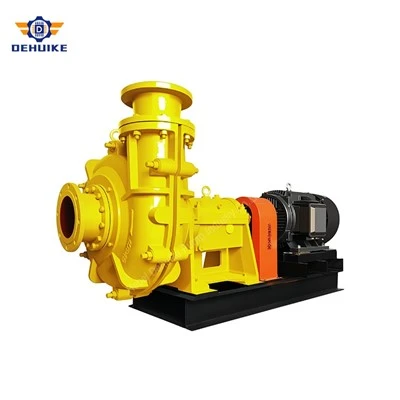
Equipment designed for handling highly abrasive materials that standard slurry pumps cannot transport.
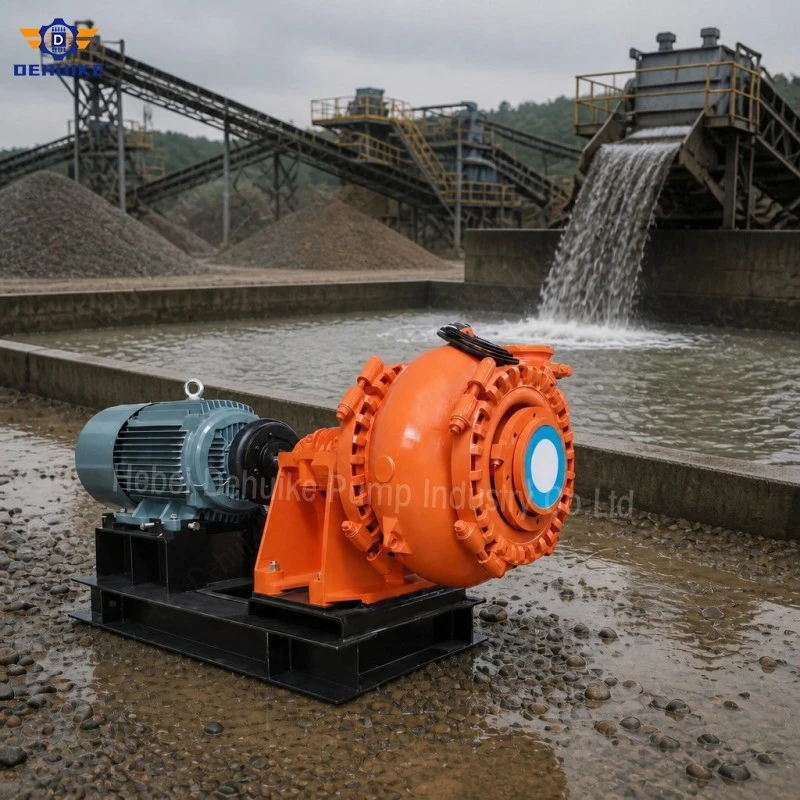
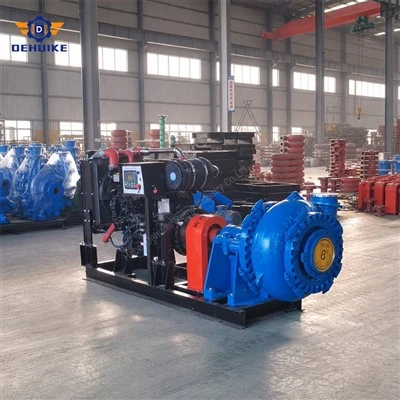
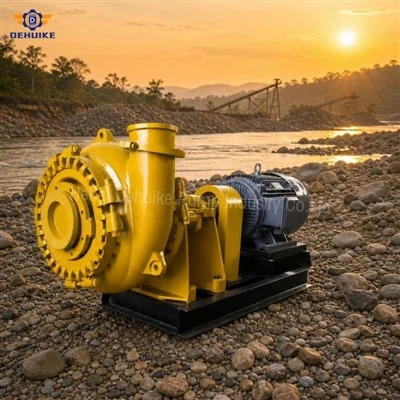
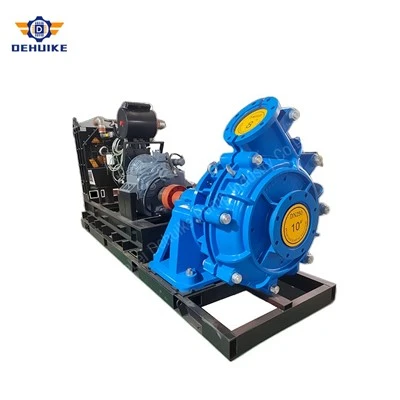
Gravel pumps are industrial units specifically engineered to transport large, highly abrasive particles. They are primarily used in applications such as dredging, mining, river channel clearance, and the transport of slag from metal smelting [2]. These pumps offer a head range of 5–80 meters and flow rates reaching 36–5,040 m³/h. They are categorized into two main types: the G series (standard) and the GH series (high-head). Various frame configurations-including B, C, D, E, F, G, and ST-are available, with the GH series specifically designed for high-head operations.
The equipment features a horizontal, single-casing centrifugal design, with the pump body and cover secured by clamps, allowing the discharge outlet to be oriented in any direction (360-degree adjustment). The flow-passage components are constructed from high-hardness, wear-resistant materials, such as high-chromium alloys (with a hardness of ≥58 HRC). Drive options include V-belts, couplings, and gearboxes, while shaft sealing solutions encompass gland packing, expeller (auxiliary impeller) seals, and mechanical seals. The bearing assembly utilizes a grease-lubricated cylindrical design, which allows for complete removal and maintenance. Optimized with wide flow passages to enhance cavitation performance, these pumps can handle particles up to 254 mm in size, making them well-suited for demanding environments such as those encountered by dredgers and sand-mining vessels.